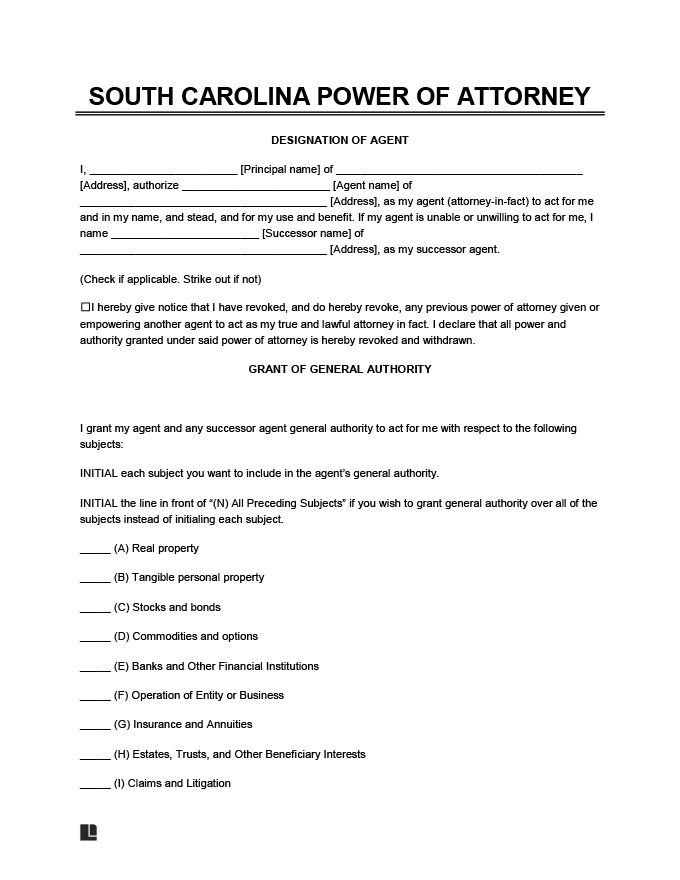
What Is a South Carolina Power of Attorney?
A South Carolina power of attorney (POA) is a legal document that gives an agent the power to act on behalf of the principal. The principal writes the agreement to outline the duties and limits of their selected agent. For a POA to be valid, the principal must be at least 18 and competent at the time of creation.
Legal Templates offers free South Carolina power of attorney templates with state-specific terms. Use our customizable form to appoint an agent and protect your interests.
Our recent study found that a lawyer in South Carolina will typically charge about $250 to create a power of attorney.
Types of Powers of Attorney in South Carolina
South Carolina recognizes a variety of powers of attorney. Evaluate the various types of POAs to determine which one works best for you.
Durable vs. Non-Durable
Depending on your needs, you can make your South Carolina POA durable or non-durable. A non-durable agreement ends the agent’s authority upon the principal’s incapacitation. For a durable power of attorney, the agent maintains their powers until the principal’s death or until the POA is revoked.
SC Code § 62-8-104 rules that all POAs are assumed to be durable unless the terms state otherwise. If you don’t want your agent to act during your incapacity, add an explicit statement of non-durability when creating your document.
Financial
A financial power of attorney outlines the terms for your agent to handle your financial assets and payments. In South Carolina, your financial POA may consist of any or all of the following authorities:
- Accessing bank accounts
- Paying bills
- Managing investments
- Handling personal property
Medical
A medical POA, more often called a health care power of attorney in South Carolina, outlines your agent’s power over medical decisions. Typically, this authorizes the agent to act on your behalf when you become incapacitated. Follow the statutory language and included conditions in SC Code § 62-5-504. Consider adding the following authorities in your health care power of attorney:
- Accessing medical records
- Deciding on treatments
- Hiring and firing caretakers
- Authorizing surgical procedures
A South Carolina advance directive and living will can be combined with your health care POA to communicate your preferences for end-of-life care.
Durable (Financial)
Gives an agent the legal authority to manage your affairs if you become incapacitated (legally unable to make your own decisions).
Signing Requirements: Two witnesses and a notary public (§ 62-8-105).
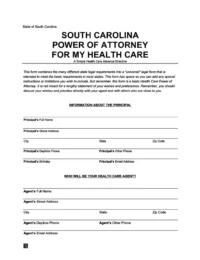
Medical
Instructs medical personnel on how to proceed with your care if you are unable to make decisions yourself.
Signing Requirements: Not specifically stated.

Limited (Special)
Allows you to give powers to an agent for a certain task (such as signing a document), and typically ends when the task has been completed.
Signing Requirements: Two witnesses and a notary public (§ 62-8-105).
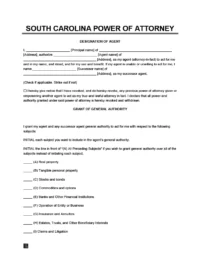
Non-Durable (General)
Lets your chosen third party (agent) make decisions relating to your financial affairs.
Signing Requirements: Two witnesses and a notary public (§ 62-8-105).
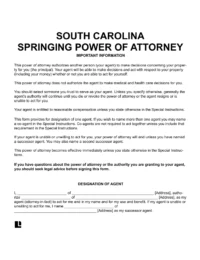
Springing
“Springs” into action and only becomes in effect in a certain situation, such as if you become incapacitated.
Signing Requirements: Two witnesses and a notary public.
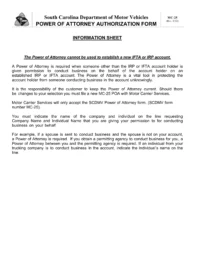
Vehicle (Form MC-25)
Appoints another person or entity called an agent or proxy to manage your vehicle-related affairs.
Signing Requirements: Notary public.
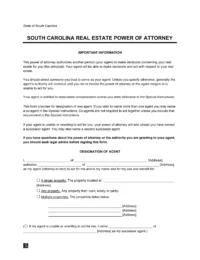
Real Estate
Appoints an agent to conduct real estate management and transactions in your absence.
Signing Requirements: Notary public and two witnesses.
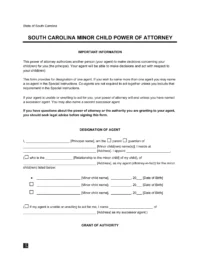
Minor (Child)
Assigns someone the right to make decisions for your child in your absence.
Signing Requirements: Notary public and two witnesses.
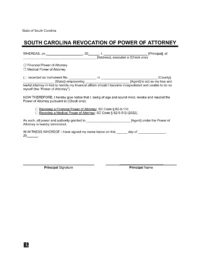
Revocation
Revokes a previously active power of attorney.
Signing Requirements: Two witnesses and notary public.
How to Write a Power of Attorney for South Carolina
Writing your POA allows you to set authorities and limitations for your agent. Consider and set the terms that meet your needs and protect your interests. Create an effective power of attorney with the following steps:
- Name the parties: Provide the principal and agent’s full legal names and addresses. Also, record any information regarding coagents or successor agents.
- Grant general authority: General powers apply to most POAs, but you can select which ones you do or don’t want to include. These often include access to bank accounts, medical records, and personal property.
- Provide specific authority: Under SC Code § 62-8-201, certain powers, such as the ability to create gifts and trusts, require an explicit statement of authorization. Add all specific powers to this section to ensure your agent’s ability.
- Set the effective date: According to SC Code § 62-8-109, a POA becomes effective at the time of signing. If you want to set a different start date or triggering event, you must specify the effective date in the agreement.
- Review and sign: Once satisfied with the terms of your agreement, the principal must sign and date the document. Also work to meet any notarization, filing, or witness requirements.
South Carolina Power of Attorney Requirements & Legal Considerations
A South Carolina power of attorney must include legal elements and considerations for notarization, filing, and revocation. These requirements ensure your agent has the right to act on your behalf while honoring your wishes.
Notarization
According to SC Code § 62-8-105, POAs generally require the principal’s signature, two witnesses, and a notary acknowledgment. Notarization ensures the signatures are presumed genuine and adds extra validity. The exact requirements vary depending on the document and its purpose.
Filing
South Carolina laws have no filing requirements for general POAs. If the agent plans to handle real estate transactions, they must file with the Register of Deeds office in the county where the property is located. In addition, financial and medical institutions may request a copy of the document to verify the agent’s authority.
Revocation
Set your POA’s revocation terms to determine when the agent’s authority expires. Some agreements end according to the terms of the contract, while others can be terminated at the request of the principal or agent. Any actions taken by the agent in good faith before they become aware of the revocation of their powers remain valid and binding. Per SC Code § 62-8-110, the following methods end an agent’s authority:
- Principal death or incapacity: Depending on the durability, a POA will automatically terminate at the time of the principal’s death or incapacity. A non-durable agreement ends when the principal becomes incapacitated, whereas a durable agreement will remain in effect until the principal’s death.
- Principal or agent revocation: Both the principal and the agent have the right to terminate the contract by providing a written notice of revocation. Acts taken by the agent prior to being notified of the revocation are still valid as long as they are done in good faith.
- Fulfillment of its purpose: Some powers of attorney focus on one specific purpose, transaction, or timeframe. In these agreements, the terms may include an automatic termination once the expressed purpose has been completed.