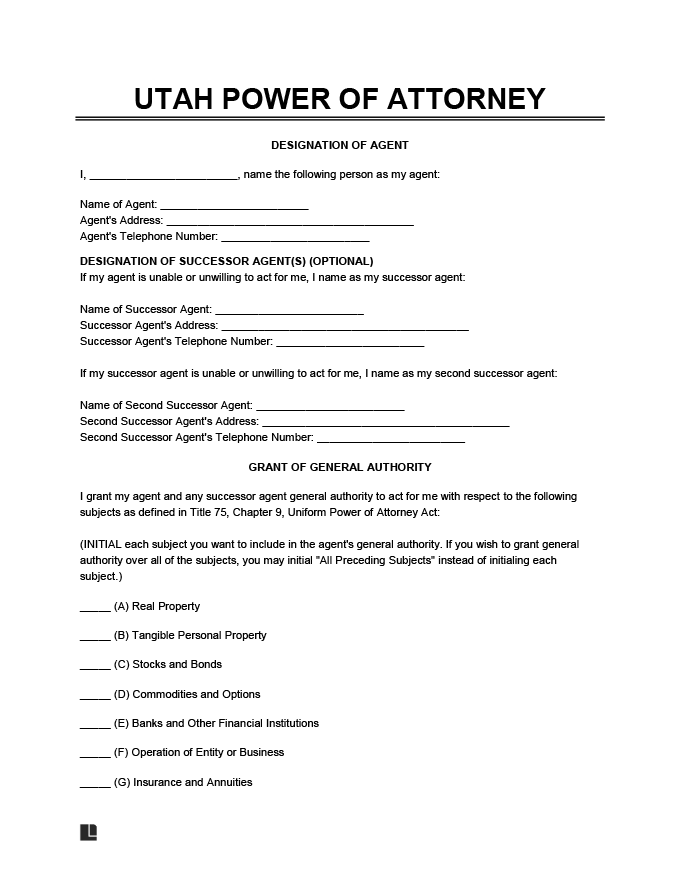
What Is a Utah Power of Attorney?
A Utah power of attorney (POA) is a contract created by a principal to select an agent to act on their behalf. The principal can tailor the POA’s terms to meet their needs and limit the agent’s powers when necessary. Creating a power of attorney requires the principal to be at least 18 and have sufficient mental capacity at the time of drafting.
Legal Templates offers a compliant Utah power of attorney form with the necessary terms and information. Use our templates to create an arrangement that works for you.
Our latest cost analysis shows that the median price for a lawyer in Utah to create a power of attorney is $275.
Types of Powers of Attorney in Utah
Powers of attorney may take many forms, depending on the principal’s desired purpose. In Utah, you can select from the different POA forms for an agreement that meets your specific needs. Evaluate the various types of powers of attorney and the relevant terms for each one.
Durable vs. Non-Durable
Utah recognizes both durable and non-durable power of attorney agreements. A durable power of attorney maintains the agent’s authority throughout the principal’s incapacity. In a non-durable POA, the agent’s abilities terminate when the principal becomes incapacitated.
Under UT Code § 75A-2-104, all POA contracts are assumed to be durable unless the terms state otherwise. Create a non-durable agreement by stating that the agent’s powers end at the principal’s incapacitation.
Medical
If you need an agent to handle your medical care and decisions, you can create a medical POA with specific terms and limits relating to health care. Use a Utah medical POA to grant or limit the following authorities for your agent:
- Accessing medical records
- Consenting to treatments
- Admitting or discharging from health care facilities
- Hiring and firing caretakers
In Utah, an advance healthcare directive serves as a medical POA with information about the principal’s healthcare preferences. Combine your healthcare directive with a living will for additional documentation of your desired end-of-life care.
Financial
When you need another person to handle your financial affairs, a financial power of attorney allows you to define their abilities. Select which of the following authorities you want your agent to exercise, as permitted by UT Code § 75A-2-204 through § 75A-2-217:
- Accessing bank accounts
- Managing investments and bonds
- Handling personal property
- Managing retirement plans
- Making business decisions
Durable (Financial)
Your agent can continue to act on your behalf if you become incapacitated.
Signing Requirements: Notary public (§ 75-9-105).
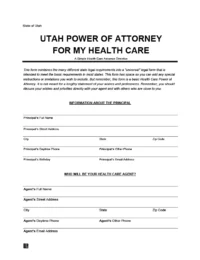
Medical
Your chosen medical care plan will become legally enforceable should you become incapacitated.
Signing Requirements: One disinterested adult (§ 75-2a-107(c)).
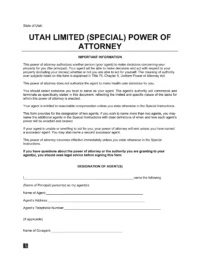
Limited (Special)
Use for narrow circumstances such as a single transaction or a short period of time, where the principal needs someone to represent them temporarily.
Signing Requirements: Notary public (§ 75-9-105).
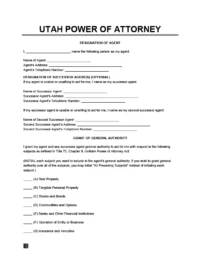
Non-Durable (General)
Provide an agent with broad authority to act on the principal’s behalf.
Signing Requirements: Notary public (§ 75-9-105).
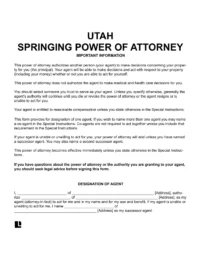
Springing
“Springs” into effect in a certain situation, and ends at a time you specify.
Signing Requirements: Notary public.
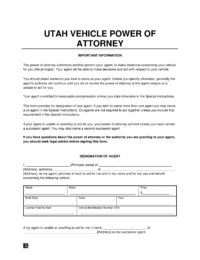
Vehicle
Permit someone to make choices regarding your vehicle when you're unavailable.
Signing Requirements: Notary public.
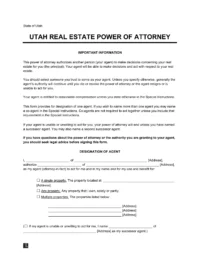
Real Estate
Grant another person the right to act on your behalf in regards to your property and real estate transactions.
Signing Requirements: Notary public.
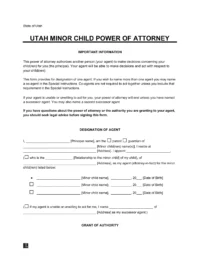
Minor (Child)
Grant someone power to make decisions relating to your child's health care, education, and extracurricular activities.
Signing Requirements: Notary public.

Revocation
Nullify any previously granted authorization to act on your behalf.
Signing Requirements: Notary public.
How to Write a Utah Power of Attorney
Drafting your Utah power of attorney requires you to input accurate information and comply with state laws. Write an effective POA agreement with the following steps:
- Identify the parties: Name the agent and principal to identify the parties involved. Provide their full names and contact information.
- Grant general power: Select which of the general powers you want to provide to your agent. Common general authorities include access to medical records, bank accounts, investments, and personal property.
- Include special authority: Under UT Code § 75A-2-201, some authorities, such as control over trusts, beneficiaries, and financial gifts, require special statements of permission. Provide explicit terms and limits for these powers for your agent.
- Set the effective date: Per UT Code § 75A-2-109, the POA becomes effective at the time of signing unless the terms state otherwise. You can add conditions to make your POA effective at a later date or at the occurrence of a specific event.
- Review and sign: After drafting your POA, review the terms and sign the form in front of a notary to ensure its validity.
Utah Power of Attorney Legal Requirements and Considerations
Power of attorney requirements vary according to state laws. Utah code defines the necessary processes for notarization, filing, and revocation. Consider the necessary elements and requirements to ensure a valid power of attorney.
Notarization
Per UT Code § 75A-2-105, the principal’s signature on a general POA is assumed genuine when acknowledged by a notary public. Advance health care directive forms may not require notarization, but they must include the signature of one disinterested adult who is not related to the principal by blood or marriage.
Filing
While Utah has no formal filing requirements for POAs, it’s highly recommended to keep and distribute copies. If the agent plans to use their authority to buy or sell real property, they must file with the County Recorder’s office in the county where the property is located. Additionally, medical or financial institutions may request a copy of the forms to verify the agent’s authority.
Revocation
When you no longer want the power of attorney to apply, you can revoke the agreement. The authority granted in a POA terminates based on the following actions, as outlined in UT Code § 75A-2-110:
- Principal’s death: In a durable power of attorney, the agent can maintain powers until terminated by the principal’s death.
- Principal’s incapacitation: With a non-durable POA, the principal’s incapacitation automatically ends the agent’s powers.
- Fulfillment of its purpose: Some agreements, such as limited POAs, include a specific purpose for the agent. In this case, the terms of the agreement specify that the POA ends upon fulfillment of this purpose.
- Principal revocation: The principal can end the terms of their POA by writing and delivering a revocation notice to the agent. This notice cancels the arrangement and ends the agent’s authority to act. Any actions taken before the revocation notice is received are presumed to be valid.
- Agent resignation: If the agent is no longer willing or able to serve, they can send an agent resignation notice to the principal to terminate the POA.
- Divorce or annulment: If the principal’s spouse acts as their agent, any action filed for the dissolution or annulment of the marriage automatically ends the POA, unless the document provides otherwise.