What Is a Security Subcontractor Agreement?
A security subcontractor agreement is a legally binding contract between the hiring contractor and a security specialist. The specialist can be an individual security guard or a security company/agency.
This document outlines the security guard’s or the company’s duties to promote safety and security. It describes what they’re responsible for, whether it be surveillance, guarding, or risk assessment.
Contractors write it when they need security services for a specific purpose. It can help them procure security for the following situations:
- For specific events
- In residential neighborhoods
- On commercial properties
- On construction sites
- To assist security firms when they need specialized services
What to Include in a Security Contract
A security contract should clearly outline the terms of security services to clarify expectations and reduce misunderstandings. Here are the key elements to include in your security subcontractor agreement:
- Parties. Identify the contractor as the hiring party. Name the subcontractor, stating whether they are a security guard or firm. Clarify that the parties do not have an employment relationship.
- Duties. Use your security services contract to describe what the security guard or company will be doing. They may be responsible for conducting surveillance, access control, or emergency response. If you add incident reporting to their job duties, provide them with Legal Templates’s security incident report template.
- Service coverage. Define the service location and coverage. For a security guard contract, you may record the area that the guard must patrol. Specify whether it should be by foot, golf cart, or patrol car.
- Equipment. Specify what equipment the security guard or company will use. It may include two-way radios, smartphones, flashlights, and body armor.
- Uniform requirements. Explain whether the guards must wear specific uniforms or plain clothes. If they will wear plain clothes and work “undercover,” ensure they carry proper identification in accordance with local and state laws.
- Weapon carrying. If you want your hired security guard to carry weapons, such as batons, pepper spray, or firearms, they must comply with applicable laws and licensing requirements. Clarify what weapons they can carry and list the state-level certifications and licenses required.
- Schedule and staffing. Your security guard services agreement should establish a clear schedule. This is especially important if the services will run late, ensuring around-the-clock coverage.
- Payment. Per the Bureau of Labor Statistics (BLS), security guards earn an average of $18.46 per hour. This figure varies depending on the scope of services and your location. You can highlight the hourly pay for a security guard or offer them a flat fee for their services.
- Insurance and indemnity. Include a clause requiring the subcontractor to hold insurance. This covers liability if issues arise regarding the subcontractor’s rendering of security services.
- Confidentiality. Protect client and site information by including a confidentiality clause. You may draft a confidentiality agreement to provide additional protection.
Sample Security Contract
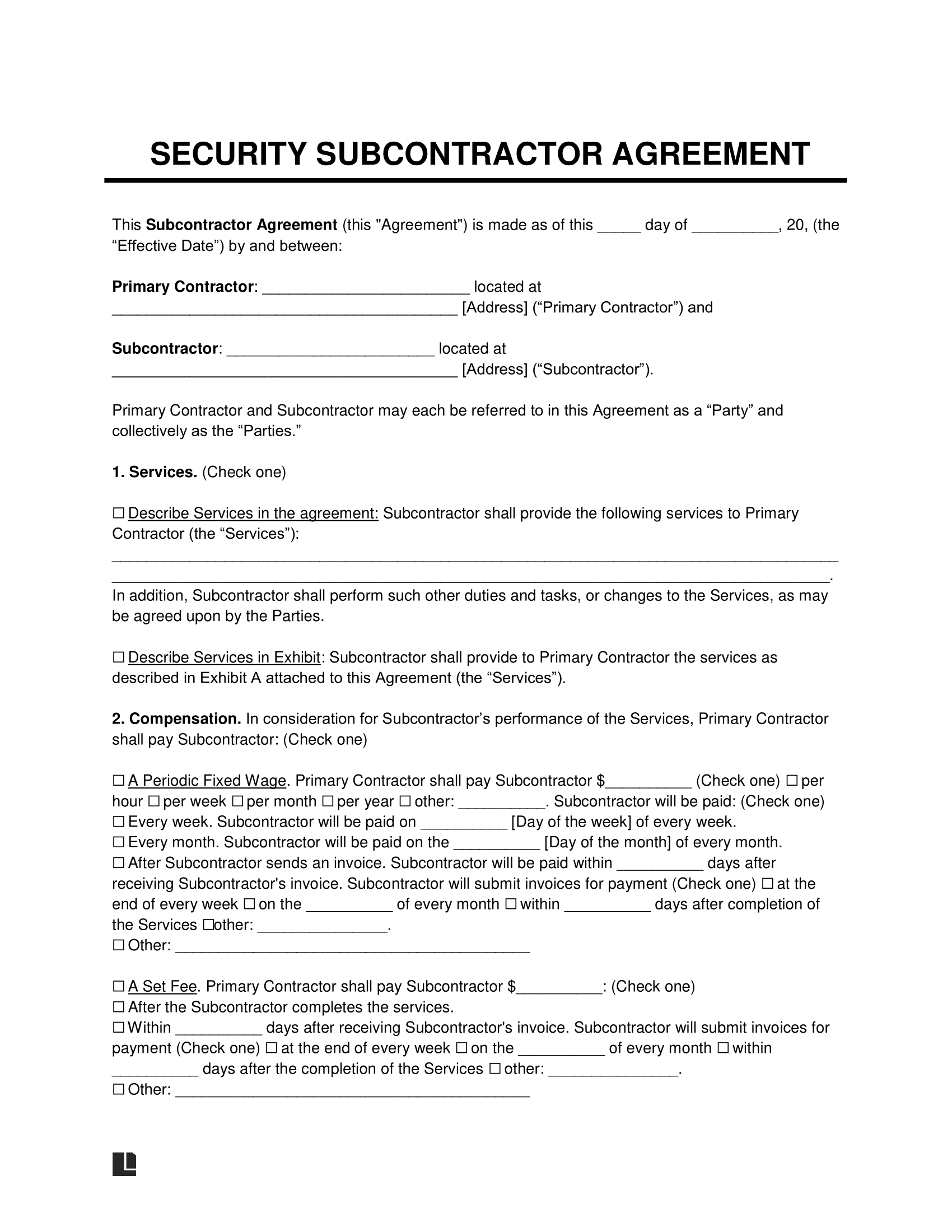
Below, you can view Legal Templates’s security services subcontractor agreement to see how to write your own. Then, create your own by answering the questions in our guided form. It will generate a final security contract for you, which you can download in PDF or Word format.