What Is a Swimming Pool Addendum?
A swimming pool addendum is a supplemental document to a lease agreement that outlines the rules for the use of a pool on the premises. It can apply to private and communal swimming areas, including pools, hot tubs, spas, and jacuzzis.
This form helps the landlord establish how the pool should be used, including access times and safety concerns. It also lets them explain who will maintain the pool, protecting its condition.
A swimming pool addendum is essential for protection from legal liability. It shields the landlord from legal claims arising from injuries or damage relating to the tenant’s use of the pool.
What to Include in a Swimming Pool Lease Addendum
When writing a swimming pool lease addendum, you can start by referring to the involved parties and the original lease. Then, you can go on to describe the pool’s rules for use, maintenance, safety guidelines, and liability provisions. Explore the key elements for your pool addendum to a residential lease agreement below.
1. Rules for Pool Use
Start by recording the rules for pool use and any restrictions in place. You can specify the following details:
- The pool’s opening and closing times
- Time limits per group during busy periods
- The number of guests each tenant is allowed to bring
- Places where tenants and their guests can park to use the pool (if it’s off the main property)
- Guidelines for noise levels
- Music and speaker policies (personal speakers allowed or prohibited)
- Rules for commercial or instructional use (no swim lessons, training, or paid events without approval)
- Rules for private events or parties
Listing these rules helps maintain order and safety, creating a positive tenant experience.
2. Maintenance Responsibilities
Specify the maintenance duties that belong to the landlord versus those that belong to the tenant. For example, the pool addendum may explain that the tenant is responsible for cleaning up after pool use, including removing trash and personal belongings. Tenants may also be obligated to perform basic surface cleaning, prevent excessive messes, and report maintenance issues.
On the other hand, landlords are often responsible for completing the following tasks, whether on their own or with the help of a hired professional:
- Chemical balancing and water treatment
- Equipment repair and replacement (pumps, filters, skimmers, drains, etc.)
- Professional pool servicing
- Structural maintenance of the pool
3. Safety Considerations
Incorporate safety guidelines into your swimming pool and spa lease addendum to protect tenants from harm. You may incorporate clauses requiring the following conditions:
- No running or pushing in the pool area.
- No breakable items in the pool enclosure.
- Pool users must comply with posted capacities or usage rules.
- Tenants must ensure all children are supervised by an adult at all times.
Be sure to follow federal requirements at a minimum. For example, the Virginia Graeme Baker (VGB) Act requires anti-entrapment safety devices in all public pools and spas to prevent evisceration, drowning, and limb entrapment. Record these devices in your addendum to inform tenants of their presence.
The US Consumer Product Safety Commission (CPSC) offers voluntary guidelines for pool safety. If your pool includes them, you should list them in the addendum to inform tenants of the safety measures in place:
- Fences on all four sides of the pool (instead of the house serving as the fourth side)
- Fences that are at least four feet tall (though at least five feet tall is preferred)
- An alarm on all doors allowing access to the pool that are loud (at least 85 decibels) and last for at least 30 seconds
- Power safety covers
There are also local guidelines to incorporate. Here are some local requirements to include in your pool addendum for a rental agreement if you live in one of the following states to show compliance:
Texas Pool Laws
Texas residential pool laws (Chapter 757, Pool Yard Enclosures) stipulate:
- Pools must be surrounded by a barrier at least four feet high, enclosing the entire pool, not made of chain-link, with no gaps over four inches.
- Gates should be self-closing, self-latching, and lockable (keypad, combination lock, padlock, or key card), with gate latches installed on the poolyard side of the gate.
- Safety systems on all potential entry points must sound alarms upon unauthorized pool access and have child-inaccessible bypass controls.
- Above-ground pool ladders must be lockable or removable when not in use.
Arizona Pool Laws
Under the Arizona Residential Landlord-Tenant Law, landlords who rent a property with access to a swimming pool must provide the tenant with a pool safety notice (AZ Rev Stat § 36-1681(E)).
Arizona also aims to protect children under the age of six in homes with swimming pools, affecting both homeowners and renters. It requires a barrier, such as a wall or fence, around both above-ground and in-ground pools unless local regulations differ (AZ Rev Stat § 36-1681(B)).
Florida Pool Laws
Florida’s Residential Swimming Pool Safety Act, Chapter 515, establishes safety protocols for residential swimming pools. Barriers must be at least 4 feet high with no gaps and separate from other fences, not directly adjacent to the pool. Above-ground pools may use their structure as a barrier if it secures access points.
Gates should open outward, be self-closing and latching, with child-proof release mechanisms. The home’s walls can be part of the barrier if unclimbable, and no nearby structures should allow climbing over the barrier.
4. Pool Waiver of Liability
Include a pool waiver of liability in your addendum stating that the tenant will use the pool at their own risk. This statement may absolve the landlord from responsibility if the tenant uses the pool negligently or carelessly.
However, note that a pool waiver of liability does not provide the landlord with absolute protection from legal liability. The effectiveness of such a waiver can vary based on circumstances and jurisdictional interpretations.
Pools and spas are often classified as “attractive nuisances.” This legal concept means that owners can be liable for injuries if the pool attracts someone, such as a child, who is harmed on the property.
Because pools increase the risk of injury, it’s important to confirm that appropriate insurance coverage is in place. The pool addendum can note whether the landlord maintains liability insurance for the pool and whether tenants must carry renter’s insurance that includes liability coverage for pool-related accidents.
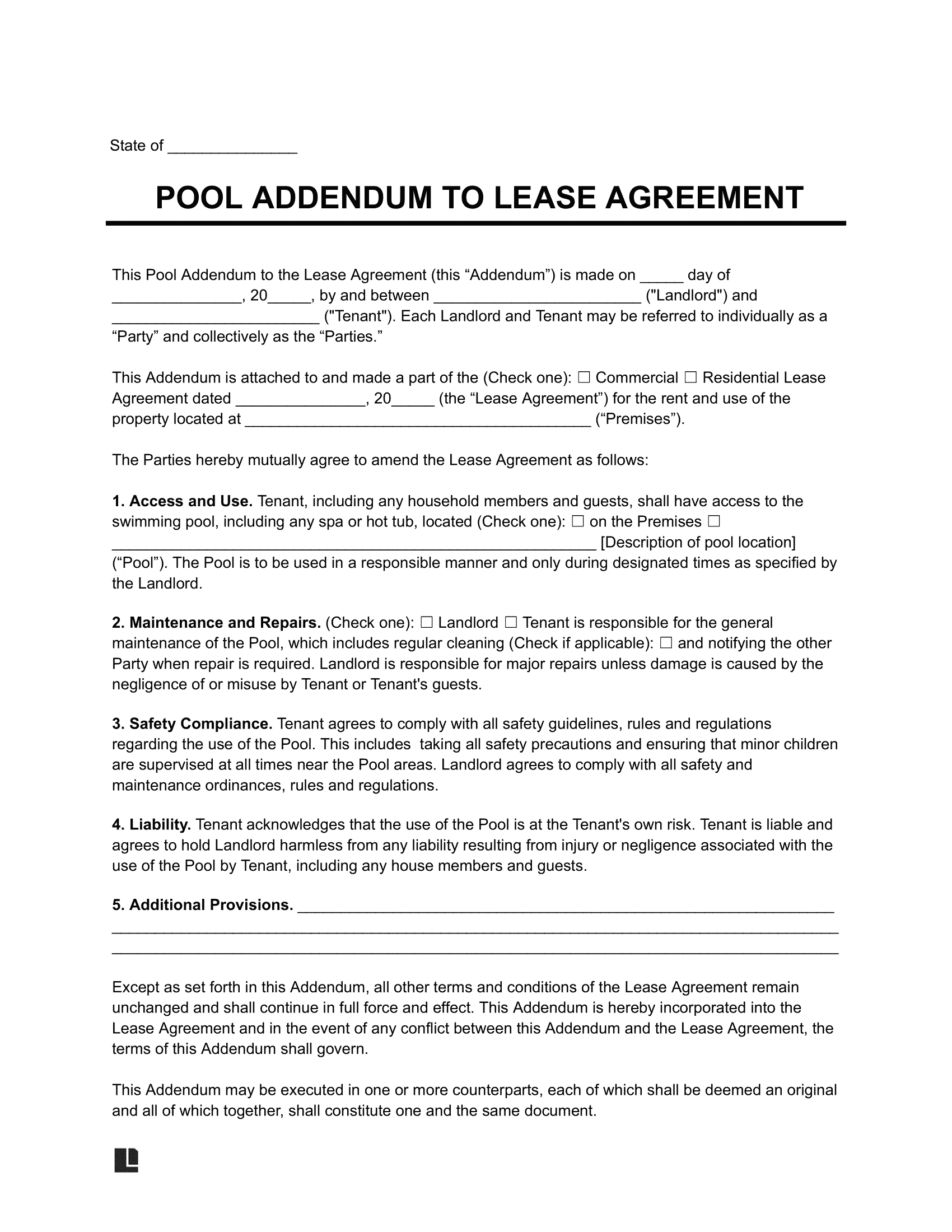
Swimming Pool Lease Addendum Sample
View an example of a swimming pool and spa lease addendum to learn how to write your provisions for pool use. Then, create your own using Legal Templates’s guided form. The final document will be ready to download in PDF or Word format for your convenience.