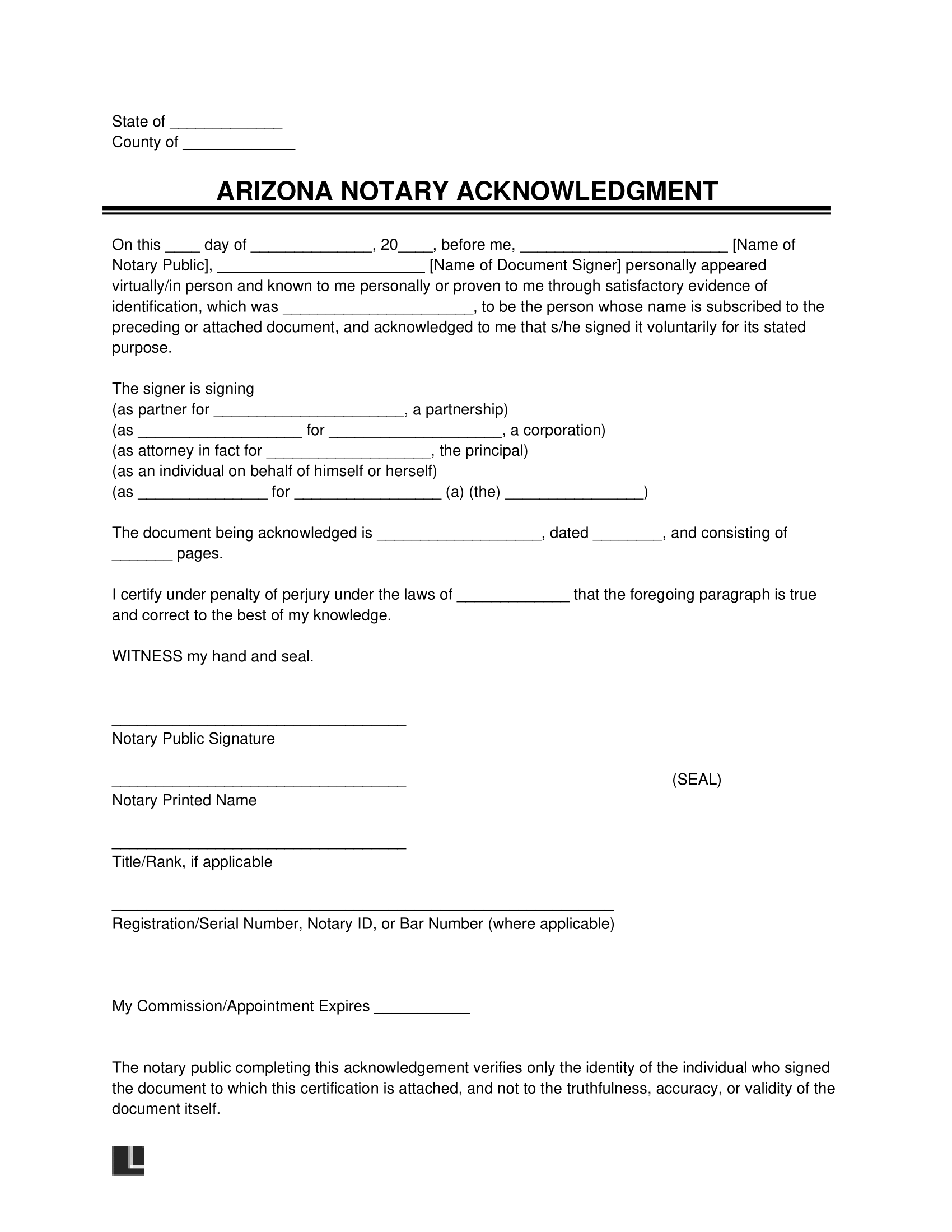
What Is an Arizona Notary Acknowledgment Form?
An Arizona notary acknowledgment form is signed by a notary public, confirming that a signer signed a legal document as themselves. To sign an Arizona notary acknowledgment form, a notary public does not have to see the signer sign the original document. As long as the signer appears before the notary, the notary only needs to confirm the signer’s identity and verify that they are signing freely.
An Arizona notary acknowledgment form does not say anything about the accuracy of the legal document’s content.
Notarization with this form helps third parties more confidently accept legal documents, such as powers of attorney. If the signer ever has to go to court, it will be harder for a court to dispute a document with a notarized signature.
Arizona state law offers a short-term certificate, present in AZ Rev Stat § 41-265. This shows how the state recognizes acknowledgments in individual and representative capacities.
What to Include in an Arizona Notary Acknowledgment Form
Under AZ Rev Stat § 41-264, an Arizona notary acknowledgment form must include the following elements:
- Signature and date: The notary public must sign and date the acknowledgment at the same time when they perform the notarial act. They must sign their name exactly as it appears on file with the Secretary of State.
- Venue: The form must include the state (Arizona) and the county where the signing occurs.
- Title of office: List the title of office of the notarial officer (either “Notary Public” or “Remote Online Notary”).
- Commission expiration: List the exact date on which the notary public’s commission expires.
- Readable language: The form must only use letters, characters, and language that the notary public understands.
- Official stamp: The notary public must affix an official stamp to the Arizona notary acknowledgment form.
- Notary’s signature: The notary public must affix their signature to the certificate once they’ve performed the notarial act. They may not add their signature before the notarial act is complete.
If the notarization is for a tangible record, a notary acknowledgment must be part of or securely attached to the record. If it’s an electronic record, the acknowledgment must be digitally linked to it.
Requirements for an Arizona Notary Public
Before completing a notary acknowledgment, an Arizona notary public must prove that they know the signer. Under AZ Rev Stat § 41-255, they can prove the signer’s identity in one of two ways:
- Having personal knowledge of the signer
- Showing a standard government-issued ID
- Having a credible witness (with a government-issued ID) vouch for the signer
Arizona Notary Acknowledgment Sample
View an example of our Arizona notary acknowledgment form. It contains all of the key elements to be compliant with state law. When you’re ready, you can fill out your own with Legal Templates’s guided form. Download it in PDF or Word format to get a printable version you can bring with you when you appear before a notary public for acknowledgment.
Is Online Notarization Legal in Arizona?
Yes, remote online notarization (RON) is legal in Arizona. Its legalization began on April 8, 2020, when Governor Doug Ducey issued Executive Order 2020-26, which authorized temporary remote notarization due to the COVID-19 pandemic. This order remained in effect until Senate Bill 1030 went into effect on June 30, 2020, making RON permanently legal.
A remote notary public’s conduct must align with the established guidelines in AZ Rev Stat § 41-263 and AZ Admin Code § R2-12-1306 for notarizing via communication technology.
Moreover, notary publics must use electronic journals to document online notarizations. Each entry is required to contain the following information under AZ Admin Code § R2-12-1309:
- The date and time of the notarial act
- A description of the document being notarized
- The signers’ full names and addresses
- Proof of identity (such as personal knowledge statement, ID verification process description, or witness identity information)
- The notary public’s fee (if applicable)
Arizona notary publics can charge up to $10 per remote notarial act, which is the same maximum charge for standard notarial acts (AZ Admin Code § R2-12-1102).
Documents That Typically Require Notarization in Arizona
In Arizona, notarization acts help protect high-stakes legal transactions. By verifying the identity of the signers, a notary public helps prevent fraud and ensures documents involving property, finances, and end-of-life planning are legally enforceable.
- Durable power of attorney
- Non-durable power of attorney
- Limited power of attorney
- Real estate power of attorney
- Minor power of attorney
- Power of attorney revocation
- Self-proving affidavit
- Warranty deed
- Quitclaim deed
- Living trust
- Small estate affidavit
While Arizona law may not strictly mandate a notary for the following forms, having them notarized makes them much harder to challenge in court: