What Is a Florida Quitclaim Deed?
A Florida quitclaim deed grants a property owner (the grantor) the ability to transfer rights and ownership of their property to another party (the grantee). The document does not guarantee the title’s status or the seller’s ownership, so it works best between trusted parties.
The grantee receives the property under the quitclaim deed “as is.” This means they can’t seek legal remedies from the grantor if the property has undisclosed title defects or liens.
In Florida, a quitclaim deed is valid indefinitely. Ownership will remain with the grantee except in rare circumstances. A court may undo a quitclaim deed if it finds evidence of fraud or undue influence.
What to Include in a Florida Quitclaim Deed
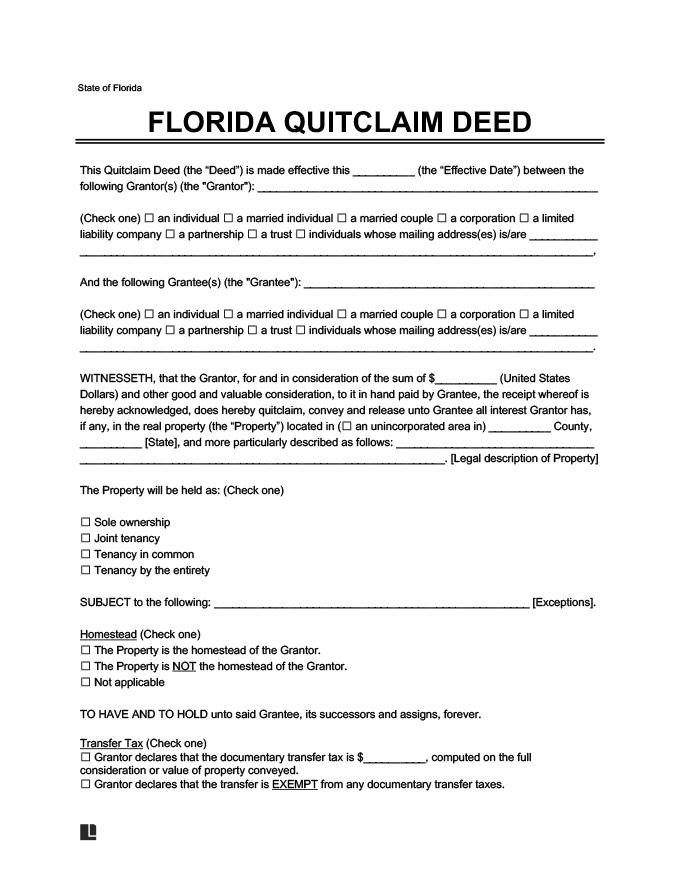
FL Stat § 689.025 offers a statutory quitclaim deed form. You can use this form or an equivalent document, but it must contain these key Florida quitclaim deed requirements per state law:
- The date on which the Florida quitclaim deed is being executed
- Grantor’s name and post address
- Grantee’s name and post address
- Amount of consideration the grantee is paying
- The Florida county where the property transfer is taking place
- Legal description of the real property
- Blank space for the real property’s parcel identification number (for recording purposes)
Sample Florida Quitclaim Deed
View an example of what a Florida quitclaim deed looks like to better understand how to fill out yours. You can use Legal Templates’s guided form to help you complete yours, then download it in PDF or Word format.
Formatting Requirements for Quitclaim Deeds in Florida
FL Stat § 695.26 outlines the formatting requirements for all deeds in Florida, including quitclaim deeds. As you’re writing yours, it’s important to adhere to the proper formatting requirements for Florida:
- Identify all grantors. Each grantor must print their name and mailing address below their signature.
- Create a “Prepared by” statement. Print the name and mailing address of the person who prepared or witnessed the preparation of the Florida quitclaim deed.
- Name all witnesses. Each witness must print their name and mailing address below their signature.
- Verify the notary. The notary’s name must appear below their signature.
- Leave the required space for the county clerk. Reserve a blank 3″×3″ space on the first page and a 1″×3″ space on each additional page for the clerk’s recording marks.
- Provide grantee information. Write the name and mailing address for each grantee.
If the paper is larger than the standard legal size (8 1/2 x 14″), FL Stat § 28.24 notes that additional fees may be charged.
How to File a Quitclaim Deed in Florida
Getting a quitclaim deed filed correctly in Florida starts with a few important steps. From gathering your documents to recording the transfer with the county clerk, here’s how to file a quitclaim deed in Florida.
Step 1 – Research Your County to Prepare
Contact the county clerk’s office in the county where the property is located or look it up online. Determine the following details:
- Recording fees
- Documentary stamp tax rates
- Any required local forms (like a Property Transfer Information Form)
- Appraiser’s parcel ID number
- Whether a self-addressed stamped envelope (SASE) is required
- Any county-specific formatting rules
- Whether the homestead rules require a spouse’s signature
Step 2 – Gather Your Documents
You may need other materials to help you fill out and file your Florida quitclaim deed:
- The current deed or title (for the legal description)
- Your government-issued ID for notarization
- Names and addresses of the grantor and grantee
- Information for the “Prepared By” and “Return To” sections
Gathering your materials ahead of time will make it easier to prepare your Florida quitclaim deed and ensure that you have everything you need.
Step 3 – Fill Out Your Florida Quitclaim Deed
Prepare your document using the language and information laid out in FL Stat § 689.025 or a quitclaim deed form. When you use Legal Templates’s form, you can rest assured that you get all the details right and comply with state law.
Ensure to Include Consideration
For a deed to be legally valid in Florida, it must involve consideration, which refers to the price or value the buyer gives the seller for the property. If you wish to transfer ownership without payment, you can specify a nominal consideration of $10.
Step 4 – Visit a Notary
In Florida, a quitclaim deed must be signed by the grantor. The grantor’s signature will be on the last page of the document, above the grantor’s printed name. If the grantor is married, both the grantor and their spouse must sign, even if only the grantor’s name is on the title.
This signing occurs in the presence of two subscribing witnesses and a notary public, per FL Stat. § 689.01.
The notary will verify the identities of the signers and ensure the witnesses sign in their presence before notarizing the deed. After notarization, the grantor should deliver the signed and notarized deed to the grantee. The grantor might also ask the grantee to sign a receipt confirming they have received the deed.
Step 5 – Record the Form at Your Local County Clerk’s Office
The grantee should make copies of the quitclaim deed and record it at the Florida County Clerk of Court office where the property is located. This means submitting the document to the county’s official records and paying a fee for this service. The fee is typically about $10 for a one-page quit claim deed, but fees may vary by county, so you should research your particular county ahead of time.
The processing time for a quitclaim deed in Florida can vary depending on several factors, including the workload of the county clerk’s office where it’s filed and whether all necessary documents are properly completed.
Generally, once the deed is submitted for recording, it may take several days to a few weeks for it to be processed and officially recorded. However, some counties offer expedited processing services for an additional fee, which can shorten the processing time.
Does a Quitclaim Deed Have to Be Recorded to Be Valid in Florida?
Recording a Florida quitclaim deed publicly shows the grantee as the new property owner, protecting the interests of both parties.
Failure to record a quitclaim deed does not invalidate the transfer of ownership between the parties involved. However, unrecorded deeds may bring about potential challenges to ownership or difficulties in proving ownership rights in the future.
How Much Does a Quitclaim Deed Cost in Florida?
Before filing a quitclaim deed in Florida, it’s important to understand the potential costs and taxes involved. Knowing what to expect can help you budget for recording fees, transfer taxes, and any federal obligations tied to your property transfer.
One cost to consider is the filing fees. The cost to file the deed is set by each county. Do your research based on your location. You can expect an average $10 fee for filing a simple one-page deed. Additional pages filed with it will increase that cost.
Taxes for Quitclaim Deeds in Florida
Using a quitclaim deed in Florida may bring about several state and federal taxes:
1. Documentary Transfer Tax
The state charges a transfer tax, also known as a Documentary Stamp Tax, for filing a quitclaim deed or any other type of real estate transfer. This tax is typically paid by the grantor. Typically, the tax rate is $0.70 per $100 of the total consideration paid for the property.
However, in Miami-Dade County, the cost is $0.60 per $100 of consideration for a single-family residence and $0.60 per $100 plus a $0.45 surtax per $100 for properties other than single-family residences, including multi-family properties and commercial properties.
Exemptions to Transfer Tax
FL Stat § 201.02 lays out several potential exemptions to the state real estate transfer tax, including:
- Quitclaim deeds intended to correct an error in a previous title or deed
- Conveyances between parties otherwise exempt from paying taxes
- Release of a mortgage
- Gifts of unencumbered property
- Property transfers with only nominal consideration
- In some cases, transferring a marital home between spouses
Consult an accountant or tax professional if you have questions about whether your transfer is exempt.
2. US Gift Tax (Form 709)
The federal gift tax is assessed on gifts of high monetary value. While there are some exemptions for gifts between relatives, real estate transactions often have enough value to be above that threshold. As a result, the IRS may assess a gift tax based on the assessed value of the property.
Typically, this tax is paid by the grantor via IRS Form 709; however, the grantor and grantee may arrange for the grantee to pay for the property. Florida does not impose a separate gift tax.
3. Capital Gains Tax
The IRS assesses a capital gains tax when the value of a piece of property, including real estate, appreciates significantly between the time the owner purchases the property and sells it. Often, real estate appreciates significantly in value, which means that the current owner can face significant capital gains taxes upon the sale.
Gifting the property can alleviate the need to pay this tax, but it means that the current owner will not receive a fair profit on the sale, and it may trigger the gift tax. Florida does not impose a separate capital gains tax.