What Is a Michigan Quitclaim Deed?
A Michigan quitclaim deed, officially referred to as Form 863, is a legal document that transfers whatever ownership interest the grantor has to the grantee. It does not guarantee that the grantor actually owns the property (MI Comp L § 565.3), nor does it promise that the property is free from liens and encumbrances.
It only transfers the grantor’s ownership as-is. It’s best used in situations where the grantor and grantee know each other well, including in divorces and in transfers between family members. This type of deed can also be used to fix small errors, like a spelling mistake on the original deed.
A Michigan quitclaim deed does not expire. It’s good indefinitely, as long as it’s recorded during the grantor’s lifetime. If it’s not recorded correctly, it may become void.
Can a Michigan Quitclaim Deed Be Created After Death?
No. A Michigan quitclaim deed cannot be created after death. The grantor must sign and record it while they’re alive. If the grantor signs a MI quitclaim deed but dies before they can record it, the deed will need to be recorded via probate or a survivorship affidavit, along with the death certificate.
What to Include in a Michigan Quitclaim Deed
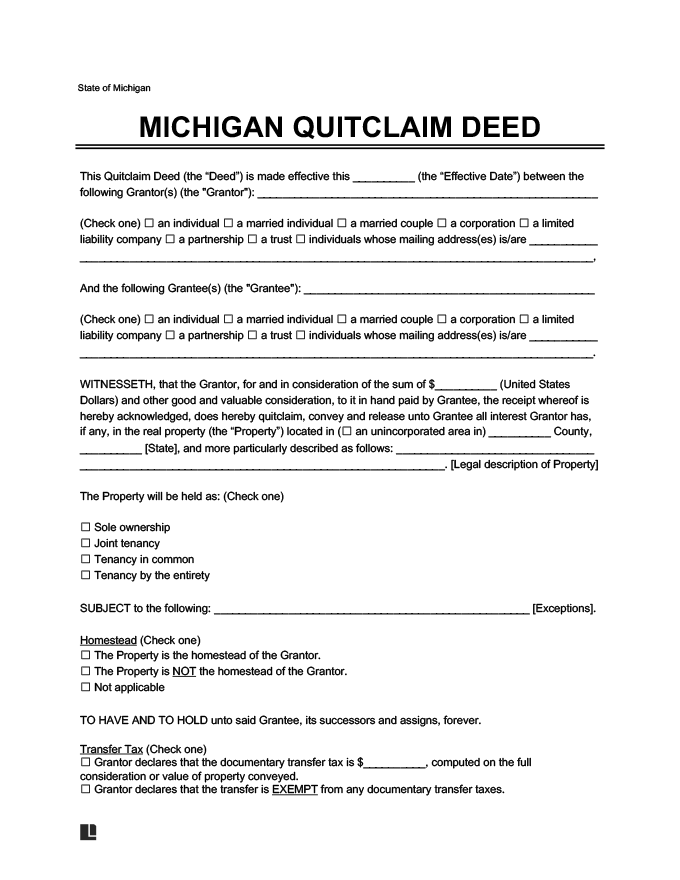
When writing your Michigan quitclaim deed, one of the most important aspects to include is a statement of conveyance. Your MI quitclaim deed should explicitly contain the word “quitclaims” and substantially represent the statutory form found in MI Comp L § 565.152.
Here are the other key elements that must make it into your MI quitclaim deed:
- The name and address of the grantor
- The name and address of the grantee
- The name and address of the party who prepared the deed
- A statement of consideration or the value paid in exchange for the property.
- The legal description of the property (including the physical address, the property’s boundaries, and other relevant information; if there is a property tax ID number, you should also include it in the legal description)
Michigan Quitclaim Deed Sample
View a free example of a Michigan quitclaim deed to get an idea of what elements to include. Then, create your own using Legal Templates’s guided form and download it in PDF or Word format.
Formatting Requirements for a Michigan Quitclaim Deed
MI Comp L § 565.201 discusses the validity requirements for all deeds, including quitclaim deeds:
- Standard or legal size paper (8.5 x 11 inches or 8.5 x 14 inches)
- Black ink on white paper
- No smaller than 10-point font
- 2.5-inch margins at the top of the first page
- 0.5-inch minimum for margins on the rest of the page
- A clear title on the first printed line that tells what the document is
Meeting these requirements ensures the recording office can file your Michigan quitclaim deed correctly and produce legible copies for future reference.
How to File a Michigan Quitclaim Deed
Filing a quitclaim deed in Michigan involves more than just signing a form. From completing the deed correctly to submitting it with the right county office, following each step ensures your transfer is legally binding.
Step 1 – Gather Relevant Paperwork and Documentation
Check the current deed to the property to get its legal description. Depending on your county and situation, you may need other documents, like the title report, to supply certain information on your MI quitclaim deed.
Step 2 – Fill Out the Quitclaim Deed
Acquire a Michigan quitclaim deed template, like the one from Legal Templates, to make the filling-out process easier. Include all the information required, such as information about the grantor and grantee, and a legal description of the property.
Step 3 – Sign Your Deed
Sign the deed as the grantor. While most states require the grantor to be in the presence of a notary public, Michigan is a little more flexible. MI Comp L § 565.8 states that the grantor can sign before a notary, clerk of a court of record, or judge.
A notary will likely be the easiest to locate for most private real estate transactions. Don’t sign the form until you’re in their presence since they need to witness the signature to validate it. You must provide a government-issued ID for proof of identity.
Step 4 – File the Deed
MI Comp L § 565.201 states that quitclaim deeds should be recorded with the register of deeds in the county where the property exists, not the county where the transaction took place or the one where either party lives. MI Comp L § 600.2567 notes that you will need to pay a $30 filing fee when submitting the deed.
Step 5 – Have the Grantee Complete a Property Transfer Affidavit
Per MI Comp L § 211.27a(10), the buyer (grantee) must file a Property Transfer Affidavit (Form 2766) with the assessor for their property’s township or city. This form confirms their acceptance of the property. They must file it within 45 days of the transfer date.
How Much Does a Michigan Quitclaim Deed Cost?
Recording a quitclaim deed in Michigan comes with a flat filing fee and potential taxes based on the property’s value. Understanding these costs can help you avoid delays and file confidently.
Filing Fees
MI Comp L § 600.2567 requires you to pay a filing fee of $30 when you submit any deed, including a quitclaim deed, to the register of deeds. Additionally, you can pay $5 to certify a recorded document and $1 per page to obtain copies of the certified document.
Real Estate Transfer Tax
Michigan charges a real estate transfer tax on the consideration for the property at the time of the sale. The state transfer tax is $3.75 per $500 of the property’s sales price.
In addition, each county can set an additional transfer tax rate per MI Comp L § 207.504. Counties with less than two million people can set an additional rate of $0.55 per $500, while counties with more than two million people can set an additional rate of no more than $0.75 per $500.
Transfer Tax Exemptions
According to MI Comp L § 207.526, there are several potential exemptions to the property transfer tax. They include the following:
- Transfers in which the total consideration for the property is less than $100
- Transfers in which the grantor is the United States, the state of Michigan, or a political subdivision of those entities
- Transfers between spouses
- Transfers to children, including stepchildren or adopted children
- Transfers to grandchildren, including step-grandchildren or adopted grandchildren
- Quitclaim deeds correcting title flaws
- A transfer between a corporation and its stockholders or creditors
- Transfers between LLCs and their members
- Joint tenancy transfers, in which one party already has a partial interest in the property
If you believe that you may be exempt from transfer taxes under these terms, consult a tax professional to pay the correct taxes on your property.
US Gift Tax
If the grantor gives property to the grantee for no consideration, they may have to pay a gift tax if the property value exceeds a certain amount. For the 2025 tax year, the grantor will have to pay gift tax on any gifts valued over $19,000 per recipient.
Note: No gift tax will be owed unless the grantor exceeds the lifetime exemption, which is $13.99 million per person as of 2025. Fill out Form 709 to report gifts and determine the amount of tax you must pay.
Capital Gains Tax
Michigan charges capital gains tax at the ordinary income rate of 4.25% regardless of the property value. If you sell the property to the grantee for a profit, you must pay the state capital gains tax.
Grantors must also pay federal capital gains tax. The federal tax rate for capital gains will vary depending on whether your gains are long-term or short-term (IRS Topic No. 409). Short-term capital gains are taxed at the normal federal income rates, so it will depend on your tax bracket. However, long-term capital gains receive special treatment and can be subject to rates of 0, 15, or 20%.