What Is a New York Quitclaim Deed?
A New York quitclaim deed is a legal document that transfers a person’s ownership rights in a property to another person. The person giving up their rights is known as the grantor. The person receiving them is the grantee. The deed transfers the property as-is, with no promises that the title is clear or that the grantor fully owns the property. Quitclaim deed forms in New York are often used to transfer property between family members where the parties already trust each other.
Legal Requirements for a Quitclaim Deed Form in New York
For a quitclaim deed to be accepted in New York, certain formatting standards and legal requirements must be met. Following these rules can help you avoid delays or rejection by the county clerk.
Party and Property Information
A New York quitclaim deed should be in writing and should list the following details accurately:
- The full legal names and mailing addresses of the grantor and the grantee
- The date of the transfer
- The consideration, even if it is a small or symbolic amount
- The complete legal description of the property
The legal description of the property must match the description used in the prior recorded deed. This may include the lot number, block number, map reference, or metes-and-bounds description. A street address alone is not sufficient for a quitclaim deed form.
Signatures and Notarization
In New York, the grantor must sign the quitclaim deed form. The grantee does not need to sign. The grantor’s signature must be notarized before the deed can be recorded. New York law requires deeds to be acknowledged under New York Real Property Law § 291. In most cases, this means the grantor signs the deed before a notary public and completes a proper acknowledgement under New York Real Property Law § 309-a.
Required New York Filing Forms and Tax Documents
In New York, you must submit additional state or city forms when recording your quitclaim deed, including a Real Property Transfer Report (New York Real Property Law § 333).
Outside New York City (All Other Counties)
If the property is located outside New York City, you must file the following documents:
- Form RP-5217 (Real Property Transfer Report)
- Form TP-584 (Combined Real Estate Transfer Tax Return and related certifications)
Form TP-584 includes the state transfer tax return, mortgage certifications, and certain income tax certifications required when property is transferred.
New York City Only (Bronx, Brooklyn, Manhattan, Queens, Staten Island)
If the property is located in New York City, you must file:
- File RP-5217NYC (Real Property Transfer Report for NYC)
- Form TP-584-NYC (Combined Real Estate Transfer Tax Return and related certifications for NYC property)
In New York City, deeds are filed online through the city’s Automated City Register Information System (ACRIS).
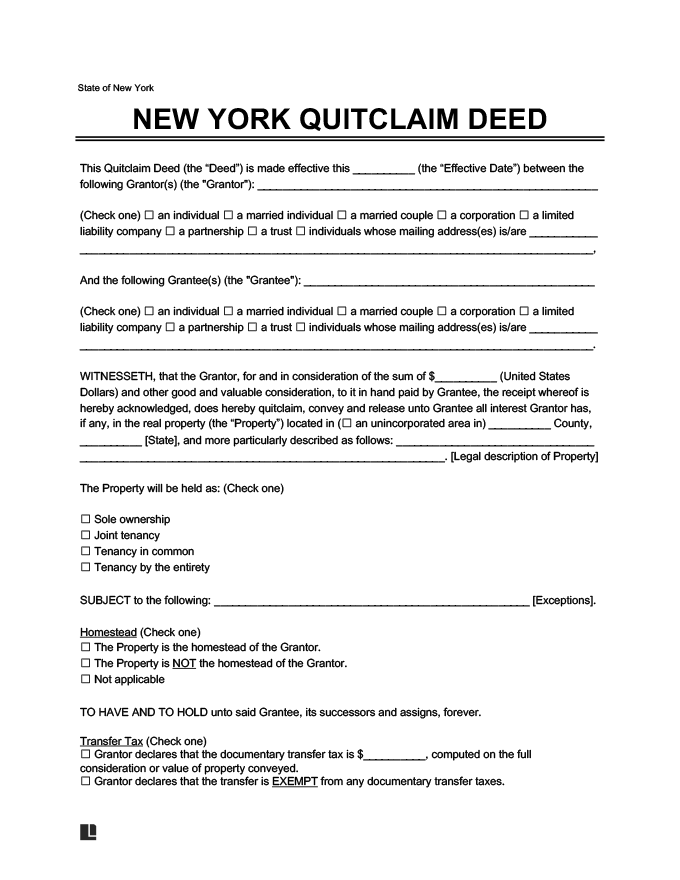
Sample New York Quitclaim Deed
Take a look at the sample New York quitclaim deed form below to see what details are typically included. Once you’re ready, fill out yours using our guided questionnaire and download your deed in PDF or Word format.
How to File a Quitclaim Deed in New York?
Here are the steps you should take to correctly complete and file your quitclaim deed form in New York.
Step 1 – Get the Prior Deed
Get a copy of the most recent recorded deed for the property. You can usually get a copy from the county clerk’s office where the property is located. Once you have a copy, you can confirm details such as the property’s exact legal description. Note that the new quitclaim deed should match the prior recorded deed exactly, especially the property description.
Step 2 – Complete Your New York Quitclaim Deed Form
Start filling in your New York quitclaim deed form with all the required information. You can complete yours using Legal Templates’s guided questionnaire that helps you fill in your information step-by-step.
Step 3 – Sign in Front of a Notary
The grantor must sign the deed, and the signature must be notarized before it is recorded. The notary public should verify the identities and complete the notary acknowledgment. If you need proper acknowledgment wording, you can also use a free New York notary acknowledgment form.
Step 4 – Complete Required Tax and Transfer Forms
Before filing your quitclaim deed, complete the required transfer and tax forms for your location. The forms differ depending on whether the property is in New York City or another New York county.
Step 5 – File the Deed
File the signed deed and required forms with the county clerk in the county where the property is located as per New York Real Property Law § 291. Recording protects the new owner against later claims. Once recorded, the transfer becomes a part of the public record.
How Much Does it Cost to File a Quitclaim Deed in New York?
The cost to file a quitclaim deed in New York depends on several factors, including the recording fees the county charges and whether a state transfer tax applies. The total amount can also vary based on the property location and the value of the transfer.
County Recording Fees
Each county in New York sets its own recording fees. Most have a base recording fee plus additional costs based on the number of pages and property type. Check with the New York county clerk’s office where the property is located to confirm the current fee schedule.
In addition to county recording fees, New York generally charges a filing fee for the Real Property Transfer Report (Form RP-5217). The fee is typically $125 for residential or farm property and $250 for other property types, but you should confirm the exact amount with the county clerk where the property is located.
New York State Transfer Tax
New York charges a real estate transfer tax on property transfers involving consideration of $500 or more. Under New York Tax Law § 1402, the tax rate is $2 for every $500 of consideration. The grantor is usually required to pay the transfer tax unless the parties agree otherwise in writing.
Some property transfers may qualify for exemptions under New York Tax Law § 1405, including certain government transfers. Exemptions from the New York transfer tax include:
- A US government entity
- A New York State entity
- A foreign government, or its representative, when the property will be used exclusively for diplomatic or consular purposes
If a government entity transfers property to a non-government entity, the non-government entity must file a return and pay the transfer tax. You can review official guidance from the New York State Department of Taxation and Finance to confirm whether your transfer qualifies for an exemption.