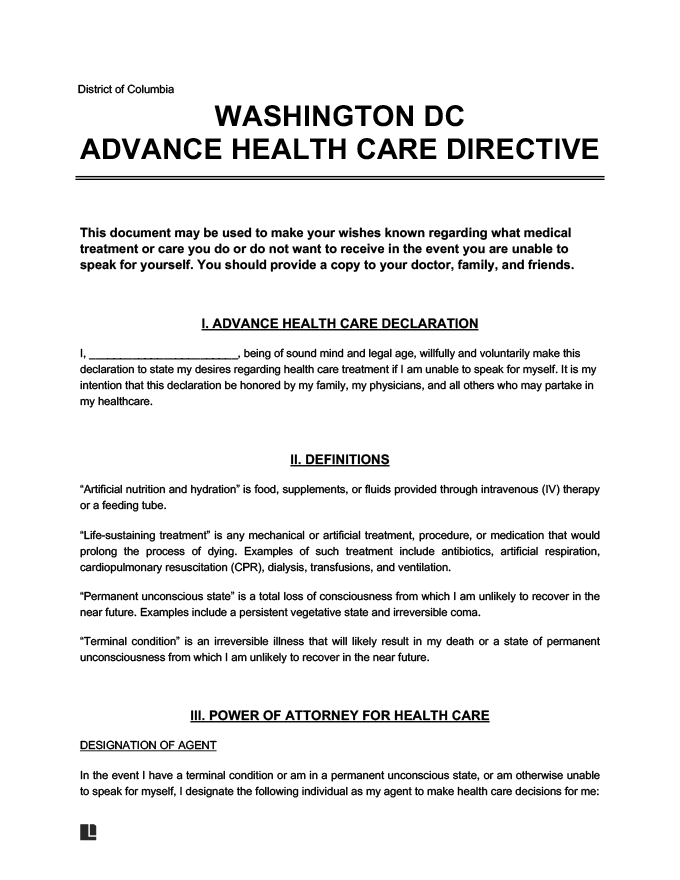
What Is a Washington, DC Advance Directive?
A Washington, DC advance directive is a healthcare form that helps you dictate your wishes for medical care. In the District of Columbia, it’s split into two parts:
- A durable medical power of attorney
- A living will (also called a declaration in Washington, DC)
A medical power of attorney (governed by DC Code § 21–2205) lets you assign an agent to make healthcare decisions if you become unable to act. You can choose which powers they gain, such as the power to consent to treatment or access medical records.
A living will declaration allows you to state your preferences for end-of-life care. Per DC Code § 7–622, a declaration becomes effective when the following conditions are true:
- You cannot make health care decisions.
- Two physicians, including your attending physician, certify that you have a terminal condition.
By completing both these documents, you can create a comprehensive document that helps doctors understand your desires.
Signing Requirements for a District of Columbia Advance Directive
An advance directive in the District of Columbia must be witnessed to affirm that the principal was of sound mind and free from duress at the time of signing.
Washington, DC Medical POA Signing Requirements
For the medical power of attorney portion, both witnesses must meet the following criteria (DC Code § 21–2207):
- Be at least 18 years old.
- Not be the attorney-in-fact, the healthcare provider of the principal, or an employee of the healthcare provider of the principal.
At least one of the adult witnesses to a DC medical power of attorney must:
- Not be related to the principal by adoption, marriage, or blood.
- Not be entitled to any part of the principal’s estate.
Washington, DC Living Will Signing Requirements
The living will declaration also has separate witness requirements (DC Code § 7–622(a)(4)). The mandatory two witnesses to a DC declaration must meet the following requirements:
- Be at least 18 years old.
- Not be the person who signed the declaration on the declarant’s behalf.
- Not be related to the declarant by blood, marriage, or domestic partnership.
- Not be entitled to any portion of the declarant’s estate.
- Not be directly financially responsible for the declarant’s medical care.
- Not be the attending physician of the declarant.
- Not be the employee of the attending physician or an employee of the health facility where the declarant is a patient.
If the declarant is a patient at an intermediate care or skilled care facility, one of the two witnesses must be a patient advocate or ombudsman (DC Code § 7–623). Otherwise, the declaration will not be effective.
Notary acknowledgment is not required for a Washington, DC advance directive, but it’s highly encouraged.
Sample Washington, DC Advance Directive
View an example of a Washington, DC advance directive to see how to outline your healthcare wishes and preferences. Complete the form with Legal Templates’s guided form, then download it in PDF or Word format. We offer a printable version so you can make copies to distribute to your agent and healthcare providers as needed.