What Is a Caregiver Contract?
A caregiver contract is a written agreement for paid care between a caregiver and the person hiring or paying them. Sometimes, the person receiving care hires the caregiver directly. In other cases, a family member hires and pays the caregiver to care for someone else.
A caregiver contract may also be called a caregiver agreement, personal care agreement, or elder care contract. It’s usually used for paid, ongoing care rather than occasional or unpaid help. The agreement can cover the caregiver’s services, schedule, work location, pay, and other key expectations. This helps everyone understand the caregiver’s role before care begins.
Does a Caregiver Contract Give Medical Authority?
No. A caregiver contract only covers services, payment, schedules, and expectations. It doesn’t let the caregiver make medical decisions, access private health information, or manage finances. Use the right form if you need to give someone legal authority:
- Medical power of attorney for medical decisions
- Medical records release form for private health information
- Durable power of attorney for finances or legal matters
When to Use a Caregiver Contract
Use a caregiver contract when paid care goes beyond a quick favor or one-time help. It can be helpful when you’re:
- Hiring a private caregiver for an aging parent, adult with a disability, or person recovering from an illness, injury, or surgery
- Paying a family member to provide care, especially if the care recipient may apply for Medicaid later
- Setting regular care hours or approved care locations
- Reimbursing the caregiver for expenses, such as mileage, groceries, or supplies
- Including daily support tasks, such as meals, errands, transportation, housekeeping, companionship, personal care, or medication reminders
Legal Templates can help you prepare a caregiver contract agreement that keeps paid care organized and easy to manage.
Need Child Care Instead?
Use a nanny contract for regular, ongoing child care in the home. Or, write a babysitting contract for occasional or short-term child care.
How Do I Write a Caregiver Contract?
A caregiver contract helps make paid care feel less informal and more structured. Use these steps to write an agreement that covers the people involved, care duties, payment, and practical rules.
1. Add the Client, Recipient, and Caregiver Names
Care arrangements don’t always involve the same person paying for and receiving care. Identify the client, care recipient, and caregiver by name. The client hires or pays the caregiver, while the recipient receives the care. For example, an older adult may hire their own caregiver, or an adult child may arrange care for an aging parent.
2. Add the Care Location
Most caregiver arrangements happen at the recipient’s home, but care may also take place at a family member’s home, assisted living residence, medical appointment, adult day program, or another agreed-upon location. If care will happen in a few different places, list each location so the contract matches how care will actually work. This helps the caregiver know where they’re expected to be and when.
3. List the Caregiver Duties
Make the caregiver’s role clear. Include what support they’ll provide and what falls outside their role so both sides understand the scope. Depending on the arrangement, the caregiver may help with:
- Preparing meals
- Helping with housekeeping
- Providing personal care
- Giving medication reminders
- Driving the recipient to appointments
- Running errands
- Providing companionship
If the caregiver will handle healthcare-related services or financial tasks, describe those duties carefully so the agreement reflects the level of responsibility involved.
4. Add the Schedule
Care needs may change throughout the day, so include when the caregiver should arrive, leave, and remain available. Add regular hours, split shifts, overnight care, expected availability, or flexible scheduling if they apply.
For example, the contract might state that the caregiver will work Monday to Friday from 8 a.m. to 11 a.m. and 5 p.m. to 7 p.m. to help with meals, medication reminders, and morning and evening routines. It could also allow weekend support when both sides agree in advance.
5. Add Compensation
Explain how the caregiver will be paid. Use a periodic wage, set fee, or another payment setup, then include when payment happens and how the caregiver will receive it.
If the care recipient may apply for Medicaid later, pay close attention to the payment structure. The caregiver’s rate should be reasonable for similar care in the area, and payments should cover future services. Lump-sum payments can make the agreement more complicated.
6. Add Expenses and Reimbursement
Caregivers may need to pay for certain costs while helping the recipient, so explain which expenses the client will repay. Common examples include:
- Mileage
- Transportation
- Groceries
- Care supplies
- Parking or appointment-related fees
You can also state whether the caregiver needs approval or receipts before reimbursement.
7. Add Time Off
Regular care can be difficult to replace on short notice, so explain what happens when the caregiver needs time away. Include any paid time off, sick leave, personal leave, or other benefits they’ll receive. If no paid leave applies, say so clearly and note how both sides will arrange coverage. I
8. Add When the Agreement Ends
State whether the agreement will run for a fixed period, end on a specific date, finish when services are complete, or continue until either side ends it. This helps both sides understand how long the care arrangement is expected to last.
9. Add Termination Notice
Explain how either side can end the contract early. For example, the caregiver may need to give 14 days’ written notice before leaving the role, while the client can include terms for ending the agreement sooner when needed.
10. Add Amendment Terms
Explain how the client and caregiver can update the agreement if the care arrangement changes. The contract may require both sides to approve changes in writing, especially if they need to adjust services, schedules, payment, or end dates.
If the care arrangement changes later, use a contract addendum to update the caregiver agreement without starting over. Both the client and caregiver should sign it so the change is documented.
11. Add Confidentiality Terms
Add confidentiality terms if the caregiver may learn private details during the care arrangement. Caregivers may see or hear sensitive information about health, finances, home life, or family matters, so the contract can require them to keep that information private during and after the agreement.
12. Add Insurance Requirements
Because the caregiver is working as an independent contractor instead of an employee, state whether they must carry their own insurance for injuries, property damage, or other work-related risks. If coverage is required, include the type of insurance and any minimum limits.
13. Pick a Dispute Process
Choose how the client and caregiver will handle disagreements before one happens. The contract can require court litigation, arbitration, mediation, or mediation before arbitration, so both sides know what steps to take next.
14. Add Governing Law
Caregiver contracts can raise different legal issues depending on the state, so identify which state’s law will govern the agreement. This will usually be the state where the caregiver provides care. State law may affect employment terms, Medicaid planning, and whether certain contract provisions can be enforced.
15. Add the Effective Date
Add the date the caregiver contract starts. This tells both sides when the caregiver’s duties, pay, and other terms take effect.
Does a Personal Care Agreement Need to Be Notarized?
Usually, no. A personal care agreement only needs notarization if state Medicaid rules require it. Signatures still matter, especially if the agreement may be used for Medicaid planning, so check your state’s Medicaid rules before relying on the document.
Caregiver Contract Example
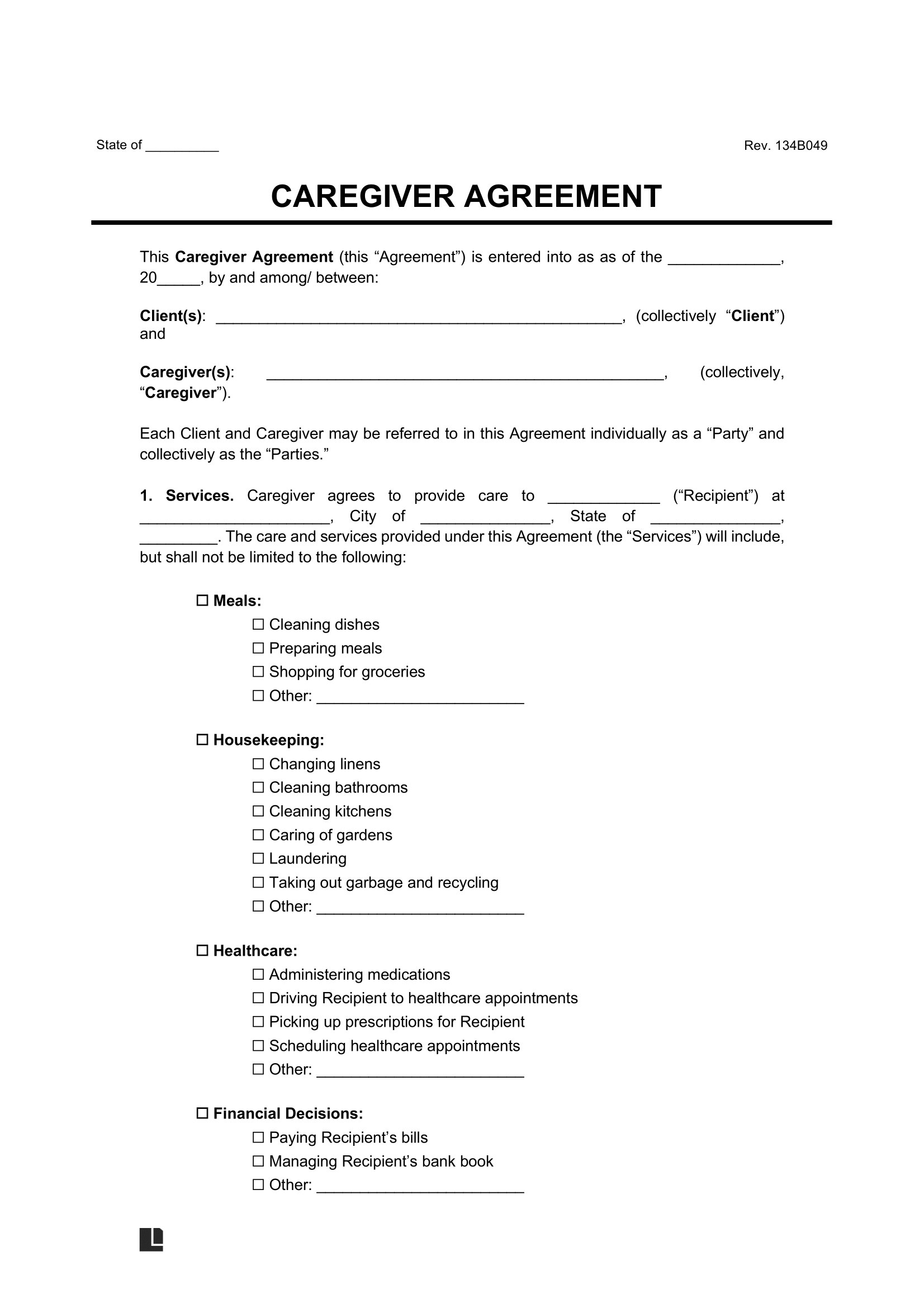
The example below shows how a completed caregiver agreement might look. It includes filled-in details for the care services, payment terms, reimbursement rules, and termination notice so you can see how the agreement works in practice.
State of Texas
CAREGIVER AGREEMENT
This Caregiver Agreement (this “Agreement”) is entered into as of August 1, 2026, by and between:
Client(s): Angela Johnson (collectively, “Client“); and
Caregiver(s): Monique Davis (collectively, “Caregiver“).
Each Client and Caregiver may be referred to in this Agreement individually as a “Party” and collectively as the “Parties.”
1. Services. Caregiver agrees to provide care to Nathaniel Coleman (“Recipient”) at 4827 Willow Creek Drive, Cedar Park, Texas 78613. The care and services provided under this Agreement (the “Services”) will include, but shall not be limited to, the following:
Meal preparation, light housekeeping, transportation to medical appointments, medication reminders, companionship, grocery shopping, laundry, and help with daily personal care.
2. Payment. In consideration for Caregiver’s performance of the Services, Client shall pay Caregiver $25 per hour, payable every Friday by electronic transfer.
3. Expenses. Caregiver will be reimbursed for reasonable expenses incurred in connection with the performance of the Services, including mileage, gas, parking, transportation, groceries, and care supplies, if approved by Client. Caregiver must provide receipts or mileage records before reimbursement.
4. Caregiver Benefits.
(A) Paid Leave. Caregiver shall be entitled to five days of paid leave per year.
5. Term and Termination. Caregiver’s engagement with Client under this Agreement shall commence on August 1, 2026.
The Parties agree and acknowledge that this Agreement and Caregiver’s engagement with Client under this Agreement shall terminate upon 14 days’ prior written notice to Caregiver. In addition, this Agreement may be terminated by Caregiver upon 14 days’ prior written notice to Client.
At the time of termination, Caregiver agrees to return all Client property used in performance of the Services, including, but not limited to, computers, cell phones, keys, reports, and other equipment and documents. Caregiver shall reimburse Client for any Client property lost or damaged in an amount equal to the market price of such property.
6. Mutual Representations and Warranties. Both Client and Caregiver represent and warrant that each Party has full power, authority, and right to execute and deliver this Agreement, has full power and authority to perform its obligations under this Agreement, and has taken all necessary action to authorize the execution and delivery of this Agreement. No other consents are necessary to enter into or perform this Agreement.
7. Caregiver Representations and Warranties. Caregiver represents and warrants that it has all the necessary licenses, permits, and registrations, if any, required to perform the Services under this Agreement in accordance with applicable federal, state, and local laws, rules, and regulations and that it will perform the Services according to the Client’s guidelines and specifications and with the standard of care prevailing in the industry.
8. Governing Law. The terms of this Agreement and the rights of the Parties hereto shall be governed exclusively by the laws of the State of Texas, without regard to its conflict-of-law provisions.
9. Disputes. Any dispute arising from this Agreement shall be resolved through mediation before arbitration.
10. Assignment. The interests of Caregiver are personal to Caregiver and cannot be assigned, transferred, or sold without the prior written consent of Client.
11. Amendments. No supplement, modification, or amendment of this Agreement will be binding unless executed in writing by both Parties.
12. Severability. If any provision of this Agreement is held to be invalid, illegal, or unenforceable in whole or in part, the remaining provisions shall not be affected and shall continue to be valid, legal, and enforceable as though the invalid, illegal, or unenforceable parts had not been included in this Agreement.
IN WITNESS WHEREOF, the Parties have executed this Agreement as of the date first written above.
Caregiver’s Signature: ______________________________
Monique Davis
Caregiver’s Full Name
Client’s Signature: _________________________________
Angela Johnson
Client’s Full Name
Private Caregiver Contract Sample
Review the caregiver contract template below to see how the care services, payment terms, reimbursement rules, and termination notice can look in a completed agreement. View sample, then customize and download your form in Word and PDF.