What Is a California Room Rental Agreement?
A California room rental agreement is a legally binding contract between a landlord and a tenant seeking to rent a specific room within a property. It can also be used when a tenant rents one of their rooms to a subtenant.
If a subtenant is involved, the primary tenant remains responsible for their original lease. Meanwhile, the subtenant is bound by the new provisions.
With a clear room rental agreement for California, the parties know what to expect regarding rent, utilities, expense-splitting, and house rules. It also helps the parties navigate shared living arrangements with roommates.
Not all original leases allow subleasing, so tenants who want to sublet a room must first obtain permission from the landlord.
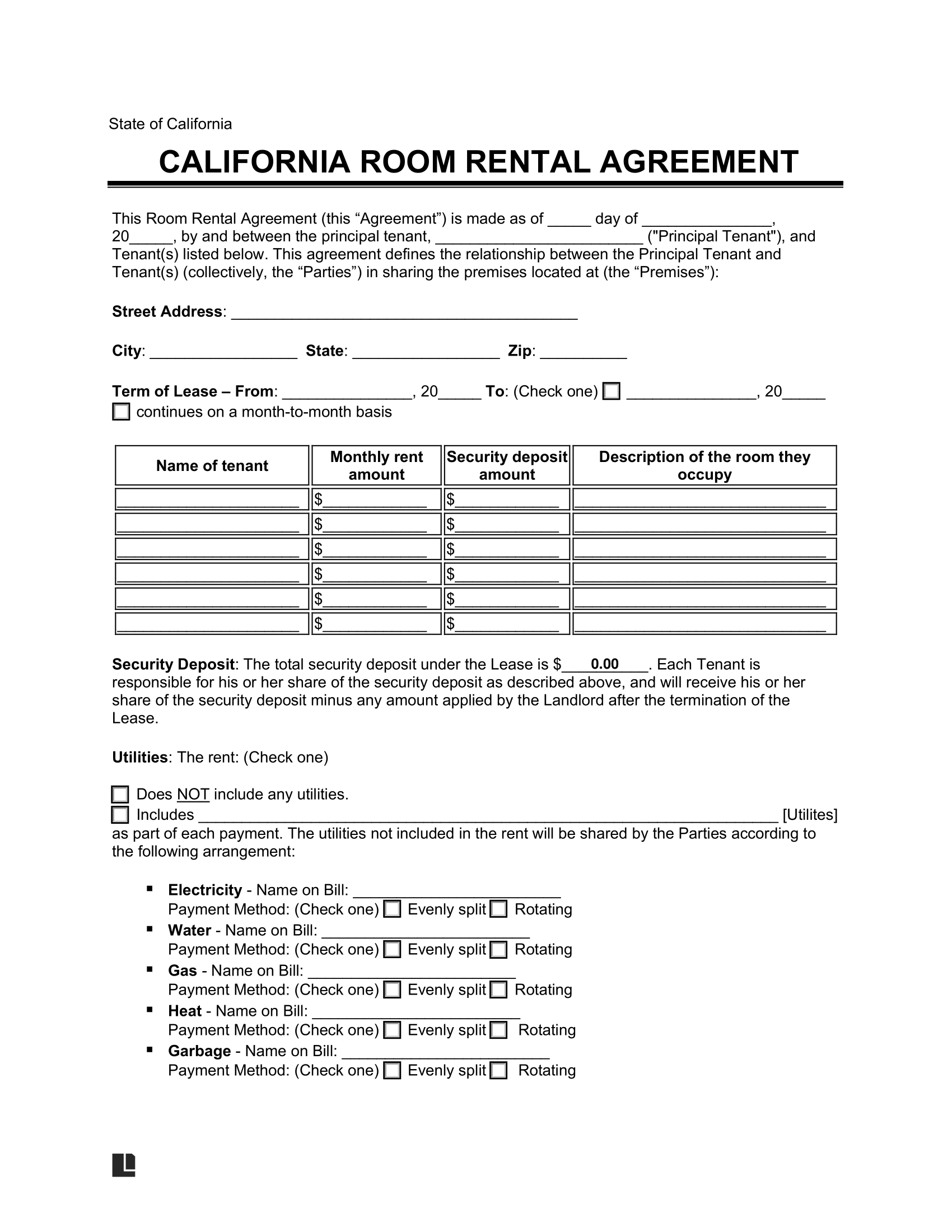
Sample Room Rental Agreement for California
View an example of a simple room rental agreement for California to understand how to write one. Then, use Legal Templates’s guided form to create your own. Download copies in PDF or Word format to keep for yourself and distribute to the tenant or subtenant.
Expectations of Privacy When Renting a Room in California
Even though a California room rental agreement involves some shared spaces, such as a kitchen, patio, or laundry room, there’s still an expectation of privacy. Landlords cannot enter a tenant’s private room without issuing proper notice. CA Civ Code § 1954 requires landlords to give reasonable notice before entering, which is presumed to be 24 hours’ notice.
Legal Considerations When Renting a Room in California
The owner of an owner-occupied, single-family home renting one room in their home to a roommate may not be subject to the California Fair Employment and Housing Act or the federal Fair Housing Act (42 US Code § 3603). For this to apply, there must not be any other roommates paying rent (CA Govt Code § 12927(a)(2)(A)).
However, there is a limited exception. The owner cannot make written or oral statements or advertise any preference or limitation based on the following factors (CA Govt Code § 12955(c)):
- Race
- Color
- Gender
- Gender expression
- Gender identity
- Sex
- Sexual orientation
- Religion
- National origin
- Ancestry
- Marital status
- Familial status
- Income source
- Disability
- Veteran or military status
- Genetic information
The owner also cannot discriminate based on additional factors, including the following (CA Govt Code §§ 51 and 51.2):
- Age
- Medical condition
- Primary language
- Citizenship
- Mental or physical disability
- Immigration status
- Personal characteristics (like a person’s physical appearance or other arbitrary characteristics)
However, a person in a single-family dwelling who advertises for a roommate can share a preference for the sex of their roommate if they will share living areas (CA Govt Code § 12927(c)(2)(B)). They may not advertise other preferences, such as the roommate’s religion or whether they attend college.