What Is a Washington, DC LLC Operating Agreement?
A Washington, DC LLC operating agreement is an internal document that sets the rules for how the LLC runs. It can govern member relationships, manager rights and duties, company activities, company affairs, and how the agreement can be changed (DC Code § 29-801.07(a)).
A Washington, DC LLC is bound by its operating agreement and can enforce it. Anyone admitted as a member is treated as having accepted the agreement, regardless of when they join the LLC (DC Code § 29-801.08(a),(b)).
A written District of Columbia LLC operating agreement gives members a shared set of rules before disputes or major decisions come up. For a single-member LLC, it can document the owner’s authority and separate business rules from personal affairs. For a multi-member LLC, it can define ownership shares, voting rights, management roles, distributions, transfers, and member exits.
A Washington, DC LLC is member-managed unless the operating agreement clearly makes it manager-managed. Choose “by members, collectively” if all members will help manage the LLC. Choose “by a designated manager” if one person or a smaller group will handle daily operations (DC Code § 29-804.07(a),(c))
Is an Operating Agreement Required in Washington, DC?
No. Washington, DC does not require LLCs to file an operating agreement to form an LLC. To form a DC LLC, one or more organizers must sign and deliver a certificate of organization to the Mayor for filing (DC Code § 29-802.01(a)). The operating agreement is separate from that filing. It is an internal document that stays with the LLC’s records.
Even though DC does not require an operating agreement, having one is still important. If the agreement does not cover an issue, DC’s default LLC rules may apply instead (DC Code § 29-801.07(b)) Those default rules may not match how the members want to run the business. A written operating agreement gives members more control over how the LLC runs. Members can use it to:
- Choose member-managed or manager-managed status
- Set rules for distributions
- Add transfer restrictions
- Define how the agreement can be changed
- Document voting rights and ownership details
- Set rules for new members, major decisions, and dissolution votes
These terms help members avoid unwanted default rules and keep key company rules in one signed document. Legal Templates can help you create a Washington, DC LLC operating agreement that covers management, distributions, transfers, amendments, and other internal terms.
Why Create One If It Isn't Required?
A written operating agreement can help show the LLC is separate from its owners, support bank account or financing requests, and reduce disputes over voting, distributions, transfers, member exits, and buyouts. It also gives members a signed record to use when questions come up later.
DC LLC Operating Agreement Rules You Should Know
A DC LLC operating agreement can change how certain DC rules apply to the company. Pay close attention to rules for distributions, transfers, and amendments. These areas can affect who gets paid, who has control, and how the agreement changes later.
DC Default Distribution Rules Use Equal Shares
DC’s default rule says distributions before dissolution and winding up are made in equal shares among members and dissociated members. That means distributions don’t automatically follow ownership percentage unless the operating agreement says so (DC Code § 29-804.04).
This can surprise members who own different percentages of the LLC. For example, a 70% owner and a 30% owner may still receive equal distributions under the default rule. Members can use the operating agreement to choose a different approach. Distributions can follow ownership percentage, capital contributions, or another formula that the members agree on.
Transfers Do Not Automatically Give Management Rights
A DC LLC member can transfer all or part of their transferable interest in the company (DC Code § 29-805.02(a)(1)). But the recipient doesn’t automatically become a full member with management rights. In most cases, the transferee can receive the distributions the transferor would have received.
A transferee does not automatically have the right to manage the LLC, participate in company affairs, or access company records (DC Code § 29-805.02(a)(3),(b)) This distinction is important. A person may receive money from the LLC or an interest in the company without getting control over how the LLC runs.
Members should use the operating agreement to set transfer restrictions clearly. Under DC law, a transfer that violates an agreement restriction is ineffective against a person only if that person had notice of the restriction at the time of transfer. (D.C. Code § 29-805.02(f))
Member approval may not be enough to change a DC LLC operating agreement. If the agreement requires outside approval or a specific condition, members must handle that first. Use an LLC operating agreement amendment to put approved changes in writing (DC Code § 29-801.09(a)).
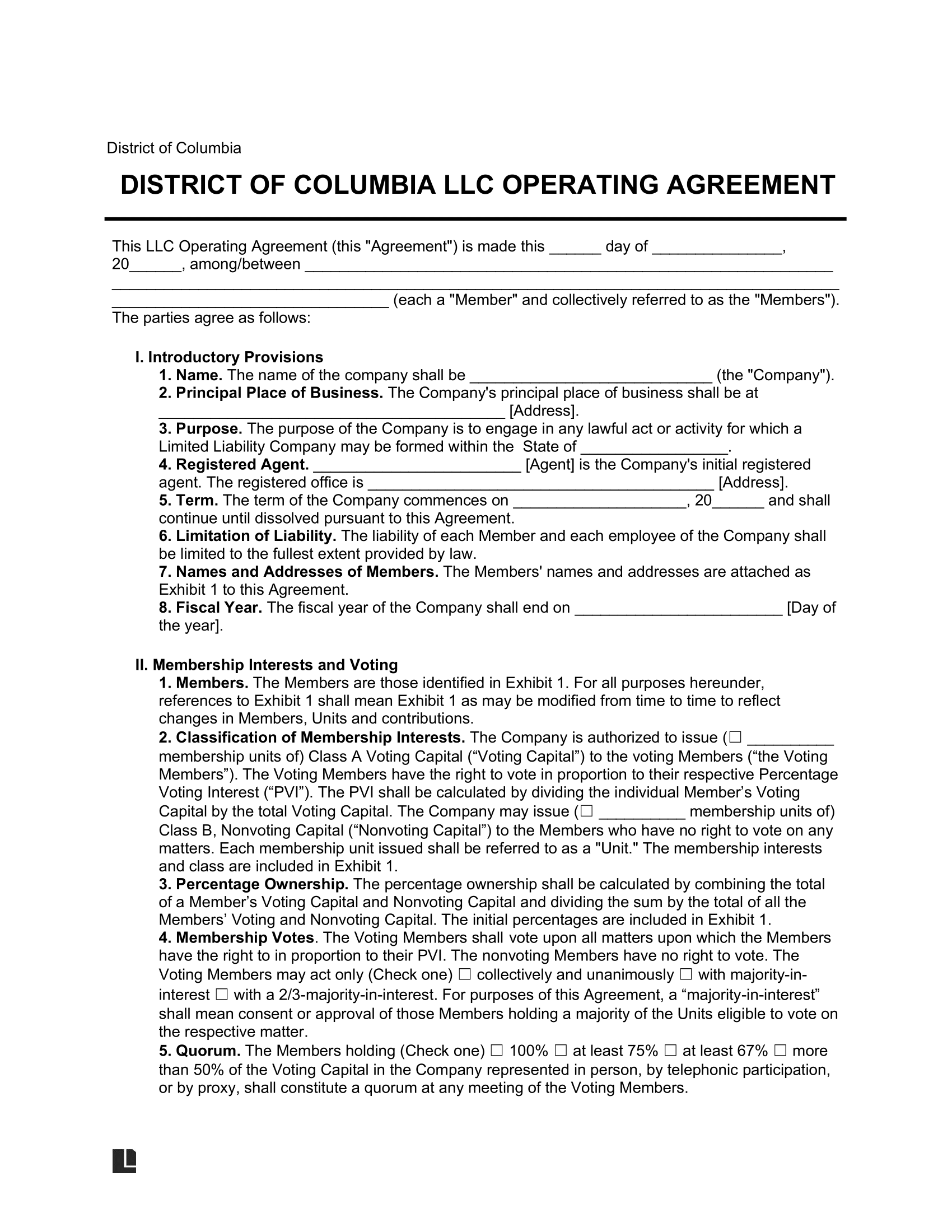
Sample Washington DC LLC Operating Agreement
View a sample Washington DC LLC operating agreement to see how the document organizes key company rules. Then customize the template with your LLC’s details and download it in Word or PDF format.