What Is a Product Development Non-Disclosure Agreement?
A product development non-disclosure agreement (NDA) keeps your product details private while you work with others. You sign it before sharing anything with a developer, designer, manufacturer, or potential partner.
It protects the details that actually give your product value. That could be features you haven’t released yet, early designs, technical specs, or a working prototype. Once the NDA is in place, the other party must keep that information confidential and can’t use it for anything outside your project.
Protection is especially important when you move past high-level ideas and start sharing real details. At that point, it’s easier for information to be reused, copied, or passed along. A product development non-disclosure agreement puts clear limits in place, so you can collaborate without giving up control of your idea.
The type of NDA you use depends on what you’re sharing:
- Use a software development NDA when sharing code, technical specs, or build details.
- Use an invention NDA if your product idea may be patented.
- Use a mutual NDA when both sides are sharing product details.
When Should You Use a Product Development NDA?
The earlier you put an NDA in place, the easier it is to protect what you’re building. You’ll typically need one in situations like:
- Before sharing specific product details like features, specs, or prototypes
- When bringing in a developer, designer, or contractor to build or review the product
- When conversations shift from high-level ideas to actual functionality
- During early stages like ideation or concept testing, when details are still evolving
For example, if you’re sending a prototype or feature list to a freelance developer, that’s the point where an NDA should already be in place. Legal Templates helps you get that protection set up quickly before anything sensitive is shared.
Use an NDA before you share anything specific. High-level discussions are one thing, but features, prototypes, and technical details are much harder to protect once they’re out. Once details are shared, you can’t fully control who has seen them.
What to Include in a Product Development NDA
As soon as you move from ideas to actual product details, your NDA needs to get more specific. You need sections that clearly define what’s being shared, how it can be used, and how long it stays protected. That usually includes:
- What you’re sharing: Explain which product details are being disclosed for development or review, such as features, prototypes, and specs.
- How long the agreement lasts (the active term of the NDA): Set how long the NDA runs, often linked to the build phase (for example, two to three years).
- How long information stays protected (the survival clause after termination): Define how long information remains protected after the agreement ends, based on how sensitive it is.
- What counts as confidential: Outline what’s covered, such as features, wireframes, prototypes, technical approach, and roadmap.
- How the information can be used: Limit use to evaluating or building the product only.
- Who is disclosing the information: Include the full legal name, whether it’s an individual or entity, and contact information.
- Who’s receiving the information: Identify the developer, designer, contractor, or partner involved.
- What isn’t protected: Clarify what’s excluded, such as public information or details already known.
- When protection starts: Confirm that protection begins before anything is shared.
- Which laws apply: Specify which state handles disputes.
When you’re handing off things like mockups, a feature list, or a build plan, these sections help keep that information contained and used only for the project.
An NDA protects what you share, not who owns what gets built. If you want rights to the final product or code, use a confidential information and invention assignment agreement to make ownership clear.
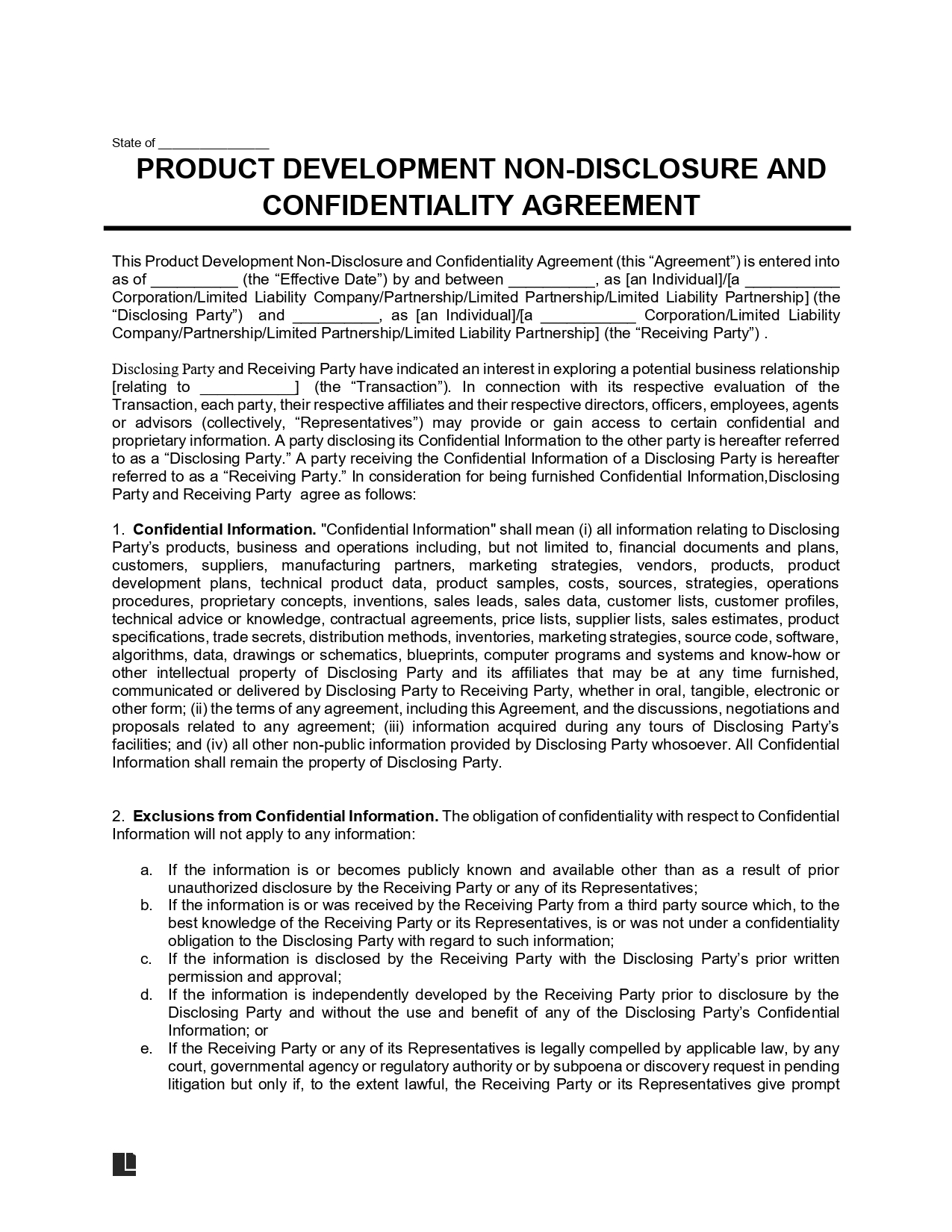
Sample Product Development NDA
Preview a sample product development NDA to see how the agreement is structured. Then customize and download your template in Word or PDF.