What Is a Georgia Minor Child Power of Attorney?
A Georgia minor child power of attorney is a legal document that allows a parent or legal guardian to temporarily give another adult certain parental powers. It is usually used for short periods when the parent cannot care for the child. This document does not transfer custody or guardianship, nor does it create grounds for the parent’s unfitness (GA Code § § 19-9-126). The parent or legal guardian still keeps their legal rights and responsibilities.
Under Georgia Code Title 19, Chapter 9, Article 4, there are specific rules for a minor child power of attorney. These rules set limits on:
- How long the authority can last
- How the form must be signed
- When the form must be filed with the probate court
Legal Requirements for a Minor Child Power of Attorney Form in Georgia
Here are the key legal requirements for a minor child power of attorney in Georgia:
Signing and Notarization Requirements
The parent or legal guardian must sign the Georgia minor power of attorney form under oath for it to be valid. The appointed agent to care for the child must also sign the form. Moreover, the form must be notarized for it to be valid (GA Code § 19-9-129(a)(1)). A Georgia minor child power of attorney may not be accepted if these steps are not followed.
You can use a free Georgia notary acknowledgment form to complete the notarization correctly.
Filing Requirements With the Probate Court
Georgia requires that you file the minor child power of attorney form with the court. Under GA Code § 19-9-129(a)(2), you must:
- File a copy of your signed and notarized form with the probate court
- File the form in the county where the child lives
- File within 10 days of signing the form
If the child moves to a different county while the minor POA is active, the agent must file the POA in the probate court of the new county. The agent must also submit a written notice of the change to the original court.
Probate Court Records and Fees
Once filed, the probate court will keep a confidential record of the form. Georgia does not charge a filing fee to register a minor child power of attorney (GA Code § 19-9-129(b)).
Notice Requirements to the Noncustodial Parent
If a parent has sole custody, they must notify the noncustodial parent within 15 days of the POA’s execution via certified mail, return receipt requested, or statutory overnight delivery (GA Code § 19-9-125). The noncustodial parent can challenge the POA within 21 days by sending notice to the person who executed it. In this case, the POA becomes void, and the child must return to the custody of the parent with sole custody.
Limitations on Granted Powers
A parent can assign most authorities regarding a child’s care and custody to an agent under a Georgia POA. However, a parent cannot assign these powers per GA Code § 19-9-124:
- The power to consent to the marriage or adoption of the child
- The performance or inducement of an abortion on or for the child
- The termination of parental rights to the child
How Long Does a Georgia Minor Child Power of Attorney Last?
Georgia law sets the duration for a power of attorney for a minor child. The duration varies depending on the situation:
- Standard Time Limit: In most situations, a Georgia minor child power of attorney is valid for up to one year (GA Code § 19-9-122). The form must clearly state the start and end dates. If no end date is included, the document may not meet the legal requirements.
- Military Parents and Grandparents: A Georgia minor child power of attorney may last longer when the parent is on active military duty or when a grandparent is appointed as the caregiver (GA Code § 19-9-132).
Ending or Revoking a Minor Child Power of Attorney in Georgia
A Georgia minor child power of attorney can end in a few different ways. It may expire on the date listed on the form, or it may end earlier if the parent or legal guardian chooses to revoke it. Parents or legal guardians can revoke a minor child power of attorney at any time (GA Code § 19-9-129(c)).
Since Georgia requires a minor child power of attorney to be filed with the probate court, the revocation works a little differently than in some other states. When a parent or guardian revokes the power of attorney, they are encouraged to file a written revocation with the same probate court where the original form was filed. This helps ensure the agent’s authority is terminated clearly and properly.
Moreover, filing the revocation also helps create a clear record and helps avoid confusion for schools, healthcare providers, and other third parties who may rely on this form. Upon receiving the revocation, the agent must return the child to the parent or legal guardian within 48 hours, unless another arrangement is agreed upon (GA Code § 19-9-130).
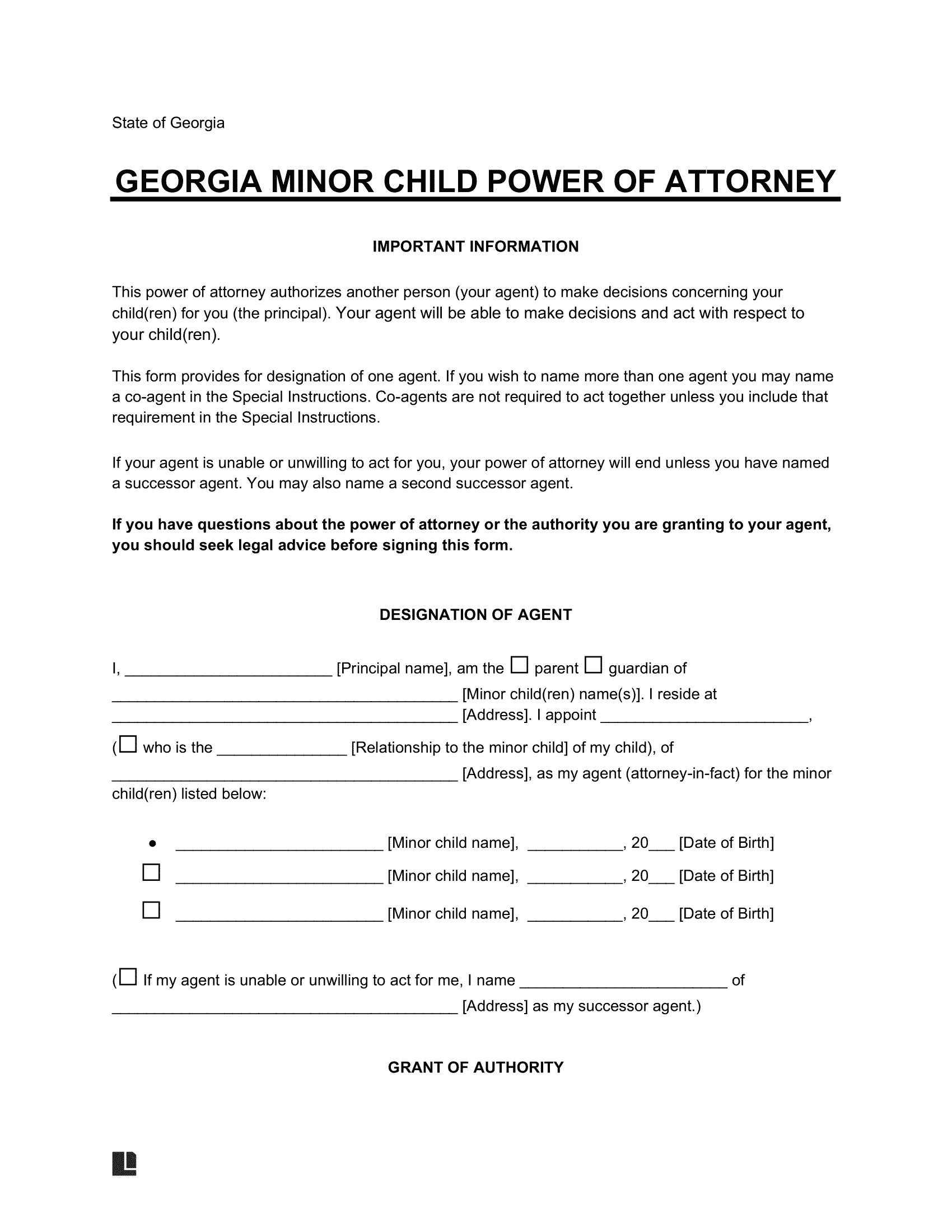
Sample Georgia Minor Child Power of Attorney
View a sample Georgia minor child power of attorney form below to see what details you’d need to include. Then use Legal Templates’s step-by-step questionnaire to complete yours, and download your GA minor child power of attorney form in PDF or Word format.