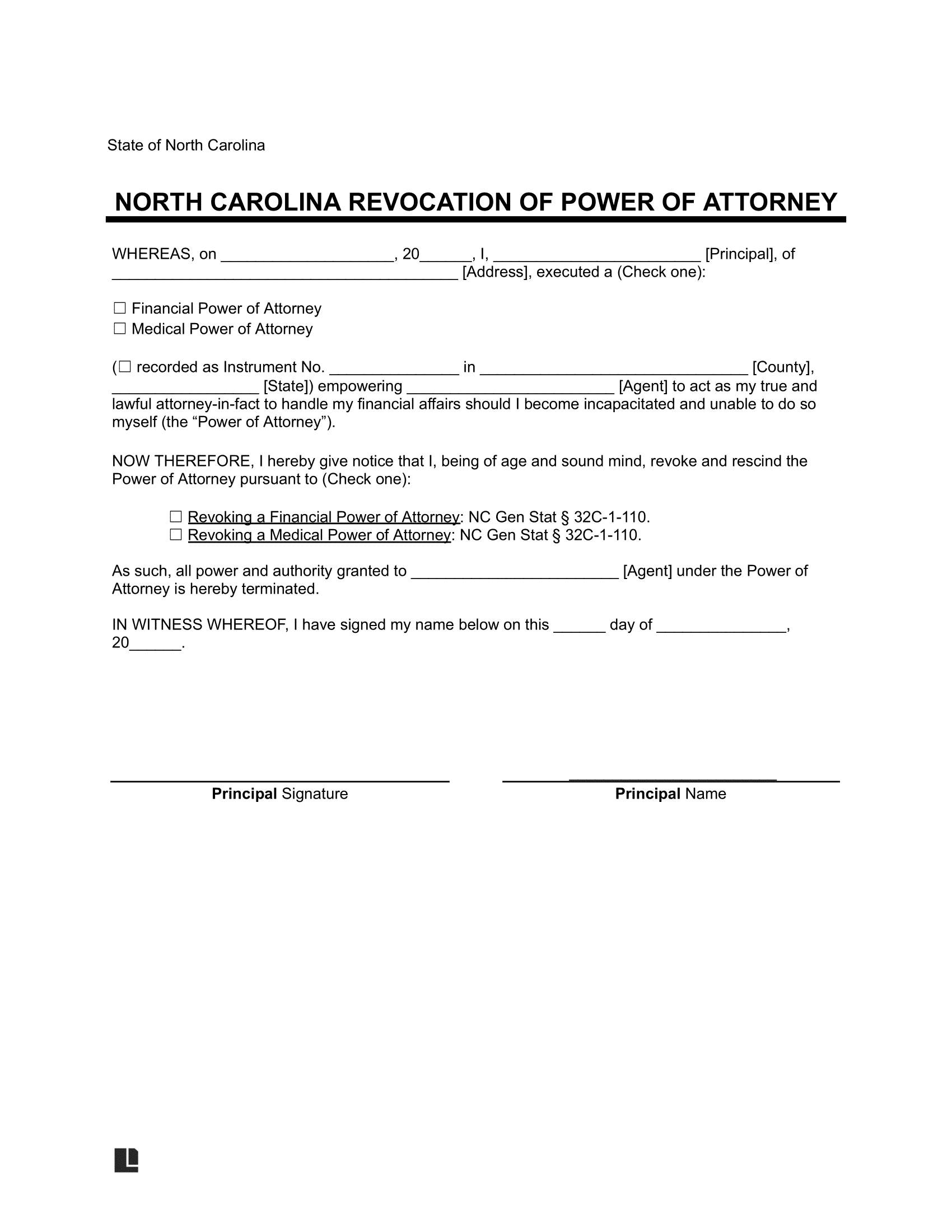
The North Carolina Revocation of Power of Attorney form is designed to formally terminate an existing POA when it is no longer necessary, or the contract requires cancellation. This form should include the primary POA contract’s details, along with the principal’s and agent’s information as specified. Once filled out, it must be signed in the presence of a notary professional for valid submission.
It is crucial to distribute copies of the signed document to your agent, backup agent, and any institutions using the POA to ensure they are aware of the revocation. A party unaware of the revocation remains not liable for continuing to operate under the POA.
Legal Considerations
Statute – North Carolina General Statutes – Chapter 32C – Uniform Power of Attorney Act (§ 32C-1-101 – 32C-4-403) and § 32A-20.
Termination Requirements – § 32C-1-110(g).
Signing Requirements – Notary Public or the document may be revoked by destruction or burnt, torn, canceled, or obliterated by the principal, or another person acting at their direction, with the intent to revoke it (§ 32C-1-110).
Revocation and Termination
Here are the key steps for revoking a power of attorney in North Carolina:
- Create a New Power of Attorney: To revoke an old POA, issue a new one that automatically negates the previous one by explicitly stating the revocation of all prior POAs.
- Draft a Revocation Letter: Alternatively, draft a revocation document if you do not wish to create a new POA. Include your name, the agent’s name, the revocation statement, and the date of the POA being revoked, declaring all previously granted powers as null and void.
- Sign and Notarize: Sign the revocation and have it notarized to verify your identity and understanding of its content. While North Carolina law does not require witness signatures, having one may offer additional security.
- Notify the Agent and Third Parties: Distribute copies of the notarized document to the former agent and any third parties like banks or healthcare providers.
- Record the Revocation: If the original POA was recorded (e.g., for real estate), do the same with the revocation at your local North Carolina Register of Deeds office.
- Safekeeping: Keep a copy of the revocation document securely to serve as proof in case of future disputes.
Fees
- Notary Fees: In North Carolina, notarizing your POA revocation document costs between $5 and $10 per signature.
- Legal Fees: You can revoke a POA on your own, but consulting an attorney is advisable for complex issues. Legal fees depend on the situation’s complexity and the attorney’s expertise, with flat rates for POA services typically ranging from $100 to $500, or variable hourly rates.
- Recording Fees: If your POA was initially registered with the local North Carolina Register of Deeds, the revocation should be recorded there too. Fees vary by county but generally range from $26 to $50.