What Is a Pennsylvania Quitclaim Deed?
A Pennsylvania quitclaim deed is a document recording the transfer of property between individuals. This type of deed includes no property or title warranties from the owner. Property transfers between family members or during a divorce settlement often use a quitclaim deed. This form also allows you to correct or update information on an existing property deed.
Legal Templates’s free Pennsylvania quitclaim deed makes it easy to prove your property transaction. Use our template to add custom terms and transfer real property.
What to Include in a Pennsylvania Quitclaim Deed
Your Pennsylvania quitclaim deed requires thorough and complete information to ensure validity. Include the following contents in your form for an effective transfer of ownership:
- Grantor and grantee information: Provide the full name, address, and contact information for the current owner and the intended recipient.
- Granting clause: Include a statement granting the recipient the rights and ownership of the property, as required by PA Stat § 21:4. Also add the phrase “release and quit claim” as stated in PA Stat § 21:7 to define it as a quitclaim deed rather than a warranty deed.
- Property description: Record the complete legal description of the transferred property and any necessary property disclosures. Include the metes and bounds, county, district, and parcel number of the property.
- Statement of consideration: Add a statement of consideration to show the exchange of money or services for the property. This statement typically includes a nominal amount, such as $10, to signify the transaction while maintaining privacy.
Additional Documents Required in Pennsylvania
Pennsylvania state laws require the owner to provide additional documentation regarding the property. Complete and attach the following forms to ensure a complete and compliant quitclaim deed:
- Certificate of residence form: Complete and attach the certificate of residence to prove your ownership and rights to the property. Include the tax mailing address and the current mailing address of the grantor to verify their information and ownership.
- Real Estate Transfer Tax Certification Form (Form 82-127): Residents of Philadelphia County must complete and file this form with the recorder of deeds to assess, pay, and verify their transfer taxes.
Pennsylvania Quitclaim Deed Formatting Requirements
State laws dictate the formatting and filing requirements for Pennsylvania quitclaim deeds. Consider the following formatting regulations to create a legally valid form:
- Recorded on standard or legal sized paper (8 1/2 x 11 inches or 8 1/2 x 14 inches)
- Clear and legible text, including a minimum 10-point font
- Dark blue or black ink that will allow for easy and clear copying
- A top margin of at least 3 inches on the first page of the document
- 1-inch margins around all sides of the page
- A title identifying the type of deed
Pennsylvania also notes that the deed must be the original copy, and the document’s acknowledgment date cannot precede the date on the document itself.
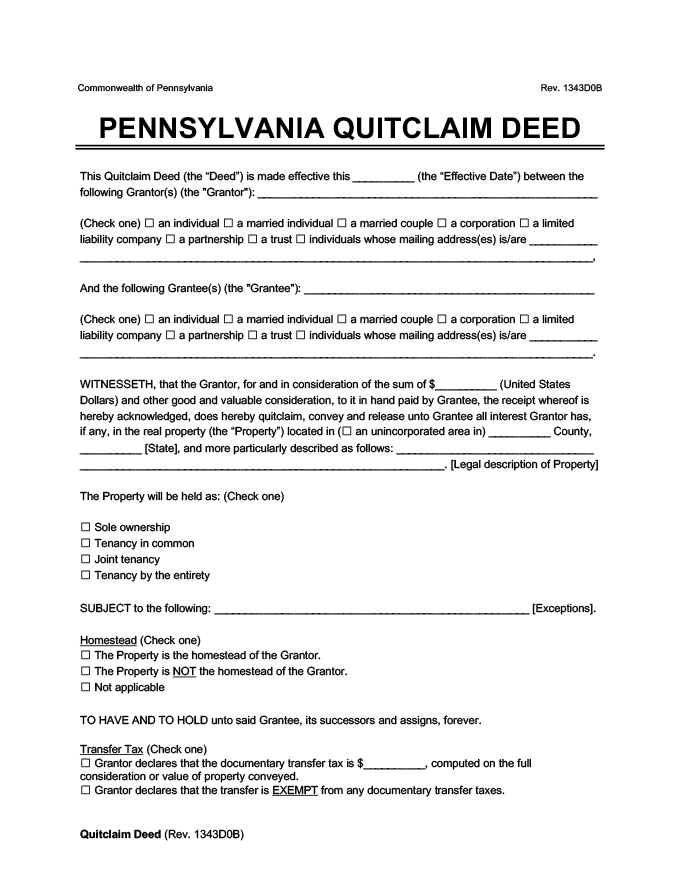
Sample Pennsylvania Quitclaim Deed
Legal Templates’s free Pennsylvania quitclaim deed form includes the necessary elements and offers customizable terms that meet your needs. Use our downloadable form, available in PDF and Word format, to create a compliant document.
How to File a Quitclaim Deed in Pennsylvania
Filing a quitclaim deed in Pennsylvania requires the parties involved to provide accurate and complete information. Use the steps below to create and file your deed effectively.
1. Identify the Parties Involved
Begin by adding information regarding the parties involved in the transaction. List the document preparer, grantor, and grantee. Include each party’s legal name, address, and contact information.
2. Describe the Property
A quitclaim deed must include a full description of the property being transferred. Record the property’s exact address and status. Also, provide the entire legal description, which can be copied from the original deed to ensure accuracy and validity.
3. Record Consideration and Taxes
A quitclaim deed requires a statement of the consideration and taxes associated with the property transfer. The consideration may be any nominal amount to signal that money has been exchanged as part of the transfer of property. Include any related state or federal tax costs relevant to the county, state, or value of the property. The grantor assumes responsibility for fees and taxes unless the terms of the deed state otherwise.
4. Sign and Notarize
PA Stat § 21.10 notes that a quitclaim deed must have the grantor’s signature and a notary acknowledgment. This ensures the deed is accepted and valid. It does not have to contain a signature from the grantee or signatures from witnesses other than the notary.
How Much Does a Pennsylvania Quitclaim Deed Cost?
The exact costs for a Pennsylvania quitclaim deed can vary depending on the county, property value, and duration of ownership. The total expenses include a mix of county, state, and federal fees and taxes. Consider the following factors and costs related to a Pennsylvania quitclaim deed.
County Filing Fees
Each county in Pennsylvania assesses its own fees for filing a quitclaim deed. In Elk County, for example, the filing fee is $79.75. The base fee for a quitclaim deed in York County is $59.75, and additional pages or documents may incur extra costs. Check the exact county where the property is located to determine the filing costs.
Real Estate Transfer Taxes
Pennsylvania also applies a transfer tax of 1% of the property value for real estate transactions. Real estate transfer tax exemptions apply in the following situations:
- Easements for agricultural, preservation, or conservation transferred to or from the commonwealth, a county, a local government unit, or a conservancy
- Historic easements
- Transfers to or by land banks
- Transfers to or from the US government or the Pennsylvania Commonwealth
- Part of a bankruptcy plan
- Transfers between husband and wife
- “Lineal ascendants and descendants,” including transfers between parents, grandparents, grandchildren, etc, and their spouses
- Transfers between siblings
- Individuals and siblings’ spouses
- Previously married individuals who owned the property together during their marriage
- Transfers into or out of trusts
Gift Taxes
Pennsylvania does not have a state gift tax; however, your quitclaim deed may require you to pay federal gift taxes. Federal gift taxes may apply depending on the property value. The IRS charges gift taxes on any amount of the value that exceeds the annual gift exemption of $19,000 for 2025.
Capital Gains Taxes
In Pennsylvania, the capital gain tax is combined with your regular income tax filing. The profit from the property transfer should be filed as income for the calendar year in which the property was sold.
Federal capital gains taxes from the IRS can also apply if the property value is significantly higher at the time of sale than it was at the time of purchase. Use Form 1040 and Schedule D to ensure proper filing and payment of capital gains taxes. Under certain IRS rules, you may be excluded from paying a federal capital gains tax if the property was held as your primary residence and you’ve lived there for a sufficient period of time before the sale.