What Is a Wyoming Quitclaim Deed?
A Wyoming quitclaim deed transfers property from the seller to the buyer without warranties. The seller “quits” their rights to the property and conveys whatever interest they may have, making it unlike a warranty deed.
This Wyoming real estate document does not guarantee the condition of the title, nor does it protect the buyer. In reality, a Wyoming quitclaim deed can transfer no interest if the seller does not have actual ownership.
Because of the nature of a Wyoming quitclaim deed, it’s used when the parties know the title status. For example, it can be used when someone wants to convey property to their sibling. It can also convey property from a parent to a child or from one divorced spouse to another. In all these cases, the parties know each other and can rely on each other’s word about the validity of the title.
No Title Guarantees With a Wyoming Quitclaim Deed
WY Stat § 34-2-105 states that a quitclaim deed transfers the property as-is with no title guarantees. It won’t transfer any title the grantor acquires in the future unless the document explicitly provides for it.
What to Include in a Wyoming Quitclaim Deed
WY Stat § 34-2-104 provides a standard quitclaim form, which includes the following elements:
- Grantor’s name(s)
- Grantor’s place of residence
- Consideration
- Grantee’s name(s)
- Date of property transfer
- Legal description
- Statement of conveyance (“conveys and quitclaims”)
- Grantor’s notarized signature
WY Stat § 34-2-106 doesn’t require using the word “release” to convey property. The document should use the word “quitclaim” for clarity. Any quitclaim deeds that grantors have previously executed are valid and have the same legal effect whether they include the term “release.”
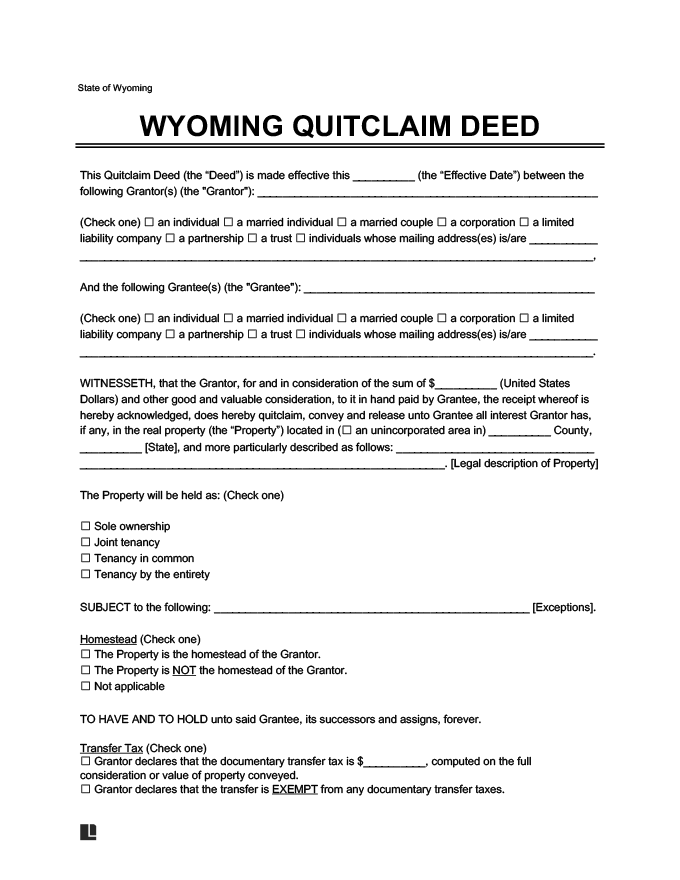
Wyoming Quitclaim Deed Sample
Below, you can view an example of a Wyoming quitclaim deed form to see how to phrase your property transfer without covenants. When you’re ready, start writing your own with Legal Templates’s guided form. The final document will be available to download in PDF or Word format.
Formatting Requirements for a Wyoming Quitclaim Deed
Practical formatting requirements, such as margins and font size, are regulated at the county level. Check with your county clerk’s office to determine the standard format you should follow. In general, all quitclaim deeds submitted for recording should be legible and originals (not copies).
Take a look at some counties’ requirements to get a better idea of what to expect. Sublette County is a more lenient county, as it only requires the following for your WY quitclaim deed to be recorded:
- Be an original (not a copy)
- Acknowledged by a notary public
- Be clearly readable and reproducible
- Names printed or typed under all signatures (except notaries and witnesses)
- Document type should be in the document title
- Property Identification Number (PIDN) (preferred but not required)
Sweetwater County has stricter formatting requirements, including the following:
- Be no larger than legal size (8.5″ x 14″)
- Have a two-inch top margin
- Have one-inch right-hand, left-hand and bottom margins on the first page (and a one-inch margin for any and all pages after)
- Have no less than a size 10 font on all pages
- Can be double-sided, but each side will count as one page to calculate fees
- Acknowledged by a notary public
- Names must be printed or typed under all signatures (except for notaries and witnesses)
- Have both a grantor and a grantee
- Be clearly readable and reproducible
- Have a legal description (if they don’t have one, they will not be abstracted in the tract indexes)
- Cover letter (preferred but not required)
Wyoming Homestead Laws
Under WY Stat § 34-2-121, if a property qualifies as a homestead, any sale or mortgage must include a written waiver of homestead rights. The owner and the owner’s spouse must both sign it for it to be legally valid.
How to File a Quitclaim Deed in Wyoming
Filing your Wyoming quitclaim deed correctly is key to making the transfer official. Follow these simple steps to complete, sign, and record your document.
Step 1 – Acquire the Original Property Deed
Obtain a copy of the original deed. This document contains the information you need to fill out your Wyoming quitclaim deed, including the current owner’s name and the property’s legal description. If you cannot locate the original deed, contact your county clerk’s office for details on acquiring it.
Step 2 – Fill Out Your Wyoming Quitclaim Deed Form
Your Wyoming quitclaim deed must be substantially similar to the form present in WY Stat § 34-2-104. Legal Templates offers a state-compliant form, ensuring you include all the key details.
Step 3 – Complete the Statement of Consideration
To file a quitclaim deed, WY Stat § 34-1-142 requires a Statement of Consideration Form, which lays out the property’s purchase price and other payment terms.
WY Stat § 34-1-142(c) outlines some instances in which the grantor doesn’t have to fill out a statement of consideration form, including the following:
- The confirmation, correction, or modification of a previously recorded instrument with no additional consideration
- A transfer pursuant to reorganizations, consolidations, or mergers of business entities
- A transfer that involves a gift of more than half of the true value
- A transfer between a parent and child or husband and wife with only nominal consideration
- A sale for delinquent taxes or assessments (or a transfer or sale relating to a foreclosure)
- A deed that transfers the property to the same party
- A transfer by a subsidiary corporation to its parent corporation without actual consideration or in consideration of the surrender of a subsidiary stock
- Any transfer that the Department of Revenue and State Board of Equalization exempts upon finding that the information isn’t relevant in determining sales-price ratios
Step 4 – Visit a Notary
WY Stat § 34-1-113 requires that a quitclaim deed be notarized. You should wait to sign and date the quitclaim deed paperwork until in the presence of a notary. Expect to take a government-issued ID to the notary for proof of identity.
Take Legal Templates’s notary acknowledgment form with you when you go to your notary appointment.
Step 5 – File Your Deed
WY Stat § 34-1-118 requires quitclaim deeds to be filed with the county clerk’s office in the county where the property is located. Consult your local office for information on the fees the county will require in advance, as different counties may have their own requirements.
Until the grantor completes the filing process, they maintain possession of the property and all associated responsibilities.
How Much Does a Quitclaim Deed in Wyoming Cost?
Wyoming quitclaim deed filings typically involve recording fees, with no major state transfer taxes in most cases. Knowing the local fees ahead of time ensures a smooth and efficient transaction.
Filing Fees
Counties in Wyoming may set their fees in accordance with WY Stat § 18-3-402, which states a $12.00 filing fee per document and a $3.00 charge for each additional page. Check your county for the exact filing fees before filing your property transfer.
Taxes
While Wyoming doesn’t charge any taxes for conveying real estate, Wyoming residents still have to pay US gift and capital gains taxes.
1. US Gift Tax
Wyoming does not have a separate gift tax. The US gift tax is assessed when one party, including a family member, gives another a gift of significant monetary value. The grantor most often pays the gift tax, which covers the property’s value.
Real estate gifts often have substantial value, so they may exceed the exemption offered for gifts given by relatives. The exemptions change yearly, so you should check with the Internal Revenue Service to learn the current year’s limits. The exemption limit is $19,000 per donee for the 2025 tax year, with the lifetime exemption currently being at $13.99 million.
2. Capital Gains Tax
Wyoming doesn’t charge capital gains tax, but grantors are still subject to federal capital gains tax. Topic No. 409 covers short-term and long-term capital gains tax information.
The capital gains tax is a tax assessed on real estate when the value of the property rises significantly from the original purchase date to the property’s sale. Real estate value can grow substantially over the years. When the time comes to sell or transfer the property, if the owner receives a significant increase in value, it may result in a capital gains tax.
The IRS allows exceptions to the capital gains tax up to a certain amount if the property was your primary residence for at least two out of the last five years (Topic No. 701).