What Is a 10-Day Eviction Notice?
A 10-day eviction notice is a written notice that tells a tenant they have 10-days to address a problem with their tenancy. Depending on the state law, the tenant may be able to:
- Pay overdue rent
- Correct a lease violation
- Vacate the property before the landlord files an eviction lawsuit
A 10-day eviction notice does not immediately remove a tenant from the rental property. Instead, it serves as a formal warning that the landlord may begin court proceedings if the tenant does not comply within the required time.
The reason for serving a 10-day notice also varies by state. Some states use this notice for nonpayment of rent. Others use it for lease agreement violations or material noncompliance. Note that certain states also use a 10-day eviction notice to terminate specific types of tenancies or address repeated lease violations. Since notice requirements vary by state, landlords should confirm that a 10-day notice is the appropriate notice for their situation before serving it to the tenant.
When to Use a 10-Day Eviction Notice
A 10-day eviction notice is typically used as a short-term warning, giving the tenant a limited window to address a problem before further legal action. It is the first formal step in the eviction process and signals that the landlord is prepared to move forward if the issue is not resolved.
Curable Violations
A curable lease violation is one that the tenant can fix within the 10-day notice period. If the tenant corrects the issue on time, the landlord may be unable to proceed with the eviction. Common curable violations include:
- Unpaid rent
- Keeping an unauthorized pet
- Allowing unauthorized occupants to live in the rental unit
- Failing to keep the property clean and in good condition
- Creating health and safety hazards
- Violating other terms of the lease
Incurable or Repeated Violations
Some states allow landlords to use a 10-day notice for violations that cannot be corrected or for repeated lease violations. Examples may include:
- Repeated lease violations: A tenant who repeatedly violates the lease after receiving prior notices may lose the right to fix the problem.
- Serious property damage: Significant damage to the rental property that goes beyond normal wear and tear may (in some cases) justify the termination of tenancy, depending on the state law.
- Criminal activity: Some states allow landlords to evict tenants for illegal activity on the property. For example, Arizona allows immediate termination for some serious criminal acts under AZ Rev Stat § 33-1368(A).
States That Allow a 10-Day Eviction Notice
A 10-day eviction notice is only available in certain states and for specific reasons. If your state is not listed below, you may need a different type of eviction notice, such as a 3-day, 5-day, 7-day, 14-day, or 60-day notice, depending on your state law and the reason for the eviction. Review your state’s eviction notice requirements before serving a tenant.
| State | Reason for 10-day notice | Curable? |
|---|---|---|
| Alaska | Noncompliance with the lease terms | Yes |
| Arizona | Serious lease violations affecting health or safety | Yes |
| Colorado | Failure to pay rent Lease violations (depending on tenancy type) | Yes Yes |
| Hawaii | Noncompliance with the lease terms | Yes |
| Illinois | Noncompliance with the lease terms | Yes |
| Indiana | Failure to pay rent | Yes |
| Kansas | Failure to pay rent | Yes |
| Maryland | Failure to pay rent | Yes |
| Missouri | Noncompliance with the lease terms | Yes |
| New York | Certain lease violations Unauthorized occupants (squatters) | Yes No |
| North Carolina | Failure to pay rent | Yes |
| Pennsylvania | Failure to pay rent | Yes |
| Washington | Noncompliance with the lease terms | Yes |
How to Write a 10-Day Eviction Notice
A 10-day eviction notice should explain why the landlord is ending the tenancy or why the landlord is demanding that the tenant correct a lease violation. By providing complete and accurate information, you can help prevent delays if the eviction proceeds to court. To write a 10-day eviction notice, you should include the following information:
- Date of Notice: Enter the date you prepare and serve the notice. This helps confirm when the 10-day notice period begins.
- Tenant and Rental Property Information: Include the full name of each tenant listed on the lease agreement, along with the complete address of the rental property.
- Rental Agreement Details: Identify and reference the applicable rental agreement for the tenancy. Be sure to include details like the lease start date.
- Reason for Notice: Explain why you are serving the notice, such as due to unpaid rent or a lease violation like unauthorized occupants.
- Amount Owed or Lease Violation: If the notice relates to unpaid rent, list the amount owed and the rental period covered by the missed payment. If the notice is for a lease violation, describe the violation in detail. For example, you may state that the tenant kept an unauthorized pet.
- 10-Day Deadline: Write the exact date by which the tenant must pay the rent, correct the violation, or move out. Note that notice periods and rules for calculating deadlines vary by state.
- Consequences of Noncompliance: Explain what will happen if the tenant does not comply within the required notice period. In most cases, this means the landlord may proceed with the eviction through a court order.
- Landlord Signature: The landlord or authorized property manager should sign and date the notice.
- Proof of Service: Keep a copy of the completed notice and document its delivery. Many states require landlords to follow specific service methods before filing for eviction.
Sample 10-Day Eviction Notice
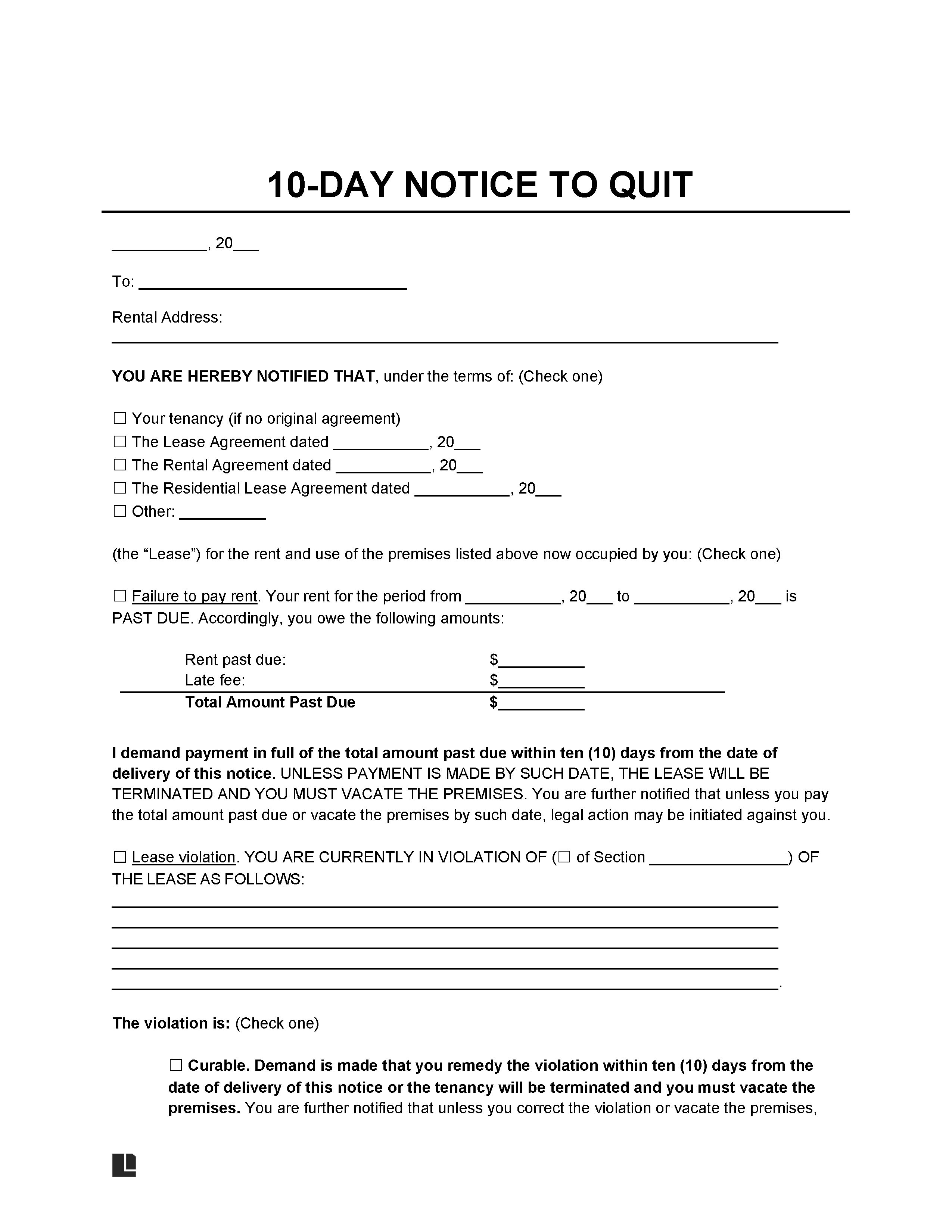
Review the sample 10-day eviction notice template below to learn how you can clearly explain unpaid rent or lease violations and outline the next steps for tenants. When you’re ready, use Legal Templates’s step-by-step questionnaire to create yours and download it in PDF or Word format.
What Happens After a 10-Day Eviction Notice is Served?
After a 10-day eviction notice is served, the next steps usually depend on the reason for the notice and the state law. The next steps depend on the tenant’s response and state law.
- Tenant Pays or Fixes the Issue: If the tenant pays the overdue rent or corrects the lease violation within the 10-day period, the landlord may not be able to proceed with the eviction. Whether the tenant has the right to correct the violation depends on the state law.
- Tenant Moves Out: A tenant may choose to move out before the notice period expires. If this happens, the tenancy generally ends. The landlord should inspect the property in that case and follow state laws regarding the return of any security deposit.
- Tenant Does Not Respond: If the tenant does not pay, fix the violation, or move out before the deadline, the landlord may file an eviction lawsuit.