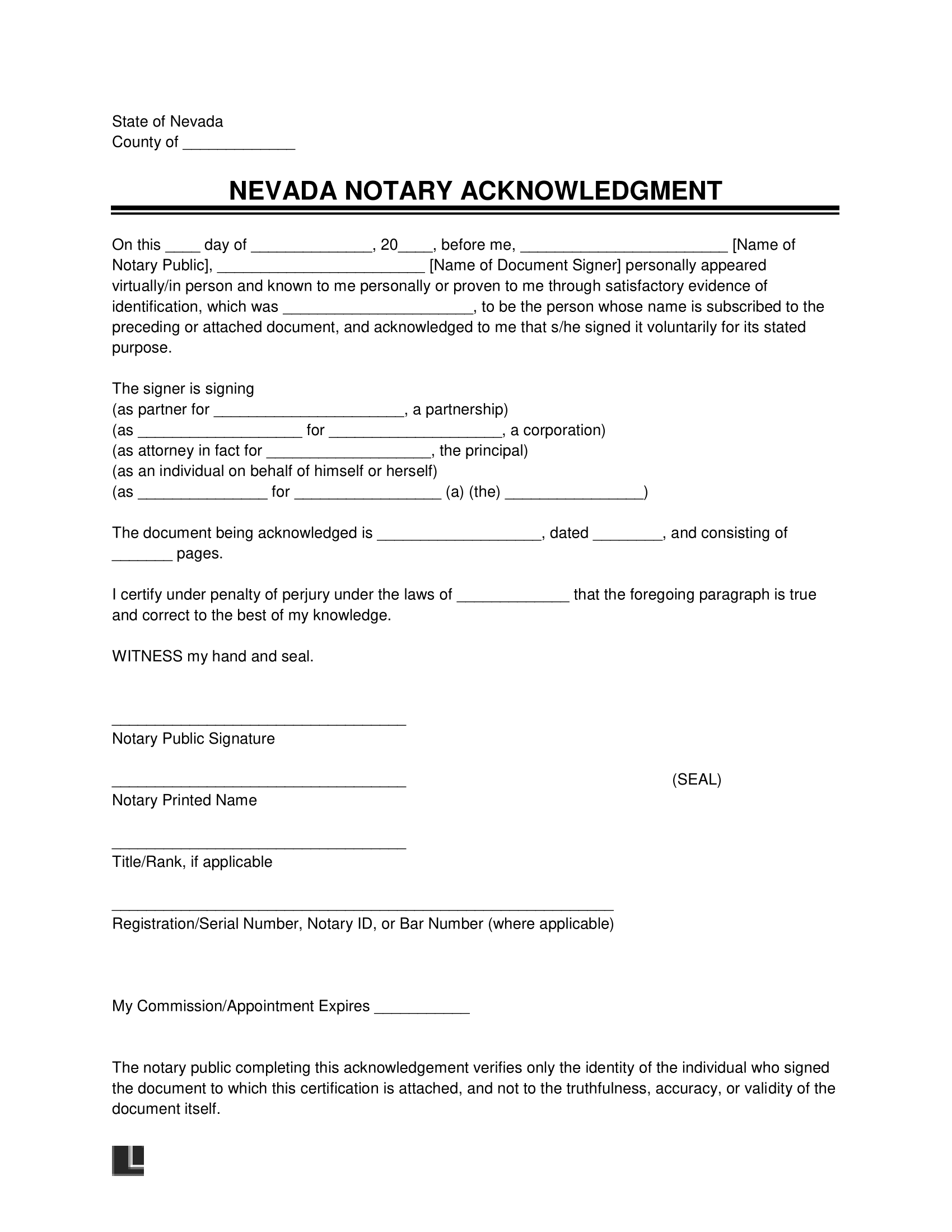
What Is a Nevada Notary Acknowledgment Form?
A Nevada notary acknowledgment form confirms that a signer says they signed a document voluntarily and for its stated purpose (NV Rev Stat § 240.002). It applies whether they’re signing for themselves or for someone else (NV Rev Stat § 240.003).
It’s a type of notarial act used to confirm a document was properly signed (NV Rev Stat § 240.004). The notary checks identity and confirms the acknowledgment. They don’t review or approve the document’s content (NV Rev Stat § 240.063).
What to Include in a Nevada Notary Acknowledgment Form
A Nevada notary acknowledgment form includes a few key details that confirm the signer signed the document and verified their signature in front of a notary. These are the main parts to include:
- Acknowledgment wording: Include language confirming the signer executed the document for its stated purpose and voluntarily signed their name.
- Short-form certificate (if used): You can use a compliant short-form acknowledgment certificate (NV Rev Stat § 240.166 through § 240.1667).
- Signer’s details: Add the signer’s name and the date of acknowledgment (NV Rev Stat § 240.120)
- Notary signature and seal: The notary must sign and apply their official stamp, including their name, title, and commission expiration date (NV Rev Stat § 240.040)
These details confirm the signer showed up, acknowledged the document, and the notary certified the transaction. Legal Templates helps you build a form with all required sections already in place.
A notary can only notarize a signature if the signer appears before them and their identity is verified (NV Rev Stat § 240.155).
Nevada Notary Acknowledgment Sample
View a sample state of Nevada notary acknowledgment form to see how it’s set up and what details it includes. Then customize your own and download the template in Word or PDF format.
Is Online Notarization Legal in Nevada?
Yes, online notarization is legal in Nevada. State law allows electronic notarization, including remote notarization completed over audio-video communication (Electronic Notarization Enabling Act; NV Rev Stat § 240.1991, § 240.1993).
Even if it’s done online, the notary still needs to make sure the signer is who they say they are (NV Rev Stat § 240.1997). The session must also be recorded and stored for at least seven years as part of the notarial process (NV Rev Stat § 240.1995).
Documents That Typically Require Notarization in Nevada
Many legal and financial documents in Nevada need notarization to be accepted, recorded, or used later. It’s especially common for documents related to property, finances, or legal authority (NV Rev Stat § 240.002). Here are some of the most common ones:
- Power of attorney forms
- Quitclaim deed forms
- Bill of sale forms
- Promissory note templates
- Affidavit templates
- Revocable living trust forms
- Last will and testament forms
- Satisfaction of mortgage forms
- Warranty deed forms
- Mortgage deed forms
- Self-proving affidavit for a will forms
- Lease agreements
Some documents don’t need notarization, but it can still help. It adds proof of who signed the document and can help avoid disputes later.
The document must be complete before notarization. A notary can’t notarize a document with blank spaces (NV Rev Stat § 240.075).