What Is a Minor (Child) Power of Attorney in Montana?
A Montana minor (child) power of attorney allows a parent or legal guardian to designate a trusted adult to care for their child for a short period of time (MT Code § 72-5-103). The agent they select may then be able to help with everyday responsibilities on behalf of the child, including:
- School-related matters
- Routine medical care
- Daily supervision
Parents may use this form when they are temporarily unavailable due to travel, illness, military service, incarceration, or other personal circumstances. Note that this form does not permanently transfer custody or parental rights. It also cannot grant the agent authority to consent to the child’s marriage or adoption.
A Montana minor child POA is best for temporary caregiving arrangements. If a child will need long-term care or there is a custody dispute, guardianship may be more appropriate. Montana guardianship statutes under MT Code § 72-5-222.
The official name for a Montana minor power of attorney is a “Power of Attorney for Care, Custody, or Property of a Minor Child.
Montana Legal Requirements for a Minor (Child) Power of Attorney
Montana law sets rules for who may create a minor power of attorney and how the form should be signed. Meeting these requirements ensures your document is accepted without delay.
Parents and Guardians Authorized To Delegate Authority
Under MT Code § 72-5-103(1), only a parent or guardian of a minor may temporarily delegate powers related to the child’s care, custody, or property through a power of attorney document.
Choosing an Agent for the Child
Montana law does not limit who may serve as the caregiver under a delegation of powers by a parent or guardian. A parent or guardian may temporarily assign caregiving authority to another person they trust. This could be a grandparent, another relative, or a trusted family friend. Before signing the form, parents should ensure the caregiver is willing and able to handle the responsibilities as part of the arrangement.
Notarization Requirements in Montana
Montana law does not specifically require notarization for a child power of attorney. However, under MT Code § 72-31-305, a signature on a power of attorney is presumed to be genuine if acknowledged before a notary public. Because of this, notarization is strongly recommended for a Montana power of attorney for care, custody, and property of a minor child form.
Ideally, the form should be signed by the parent or legal guardian and notarized. You can use a Montana notary acknowledgment form to complete the notarization before a notary public.
How Long Does a Montana Power of Attorney for Care, Custody, and Property of a Minor Child Last?
A Montana child power of attorney may last up to six months. Parents and legal guardians can choose a shorter time period if needed. Note that under MT Code § 72-5-103, the six-month limit does not apply to certain military service members, including:
- Active-duty members of the United States military.
- Members of the Montana National Guard serving more than 180 continuous days.
- Members of the federal reserves serving more than 180 continuous days under Title 10 of the United States Code.
Revoking a Minor (Child) Power of Attorney in Montana
A parent or guardian can revoke a Montana child power of attorney at any time. Revoking the form terminates the caregiver’s authority to act on behalf of their child. While Montana does not require a written revocation, creating one can help you avoid confusion with schools, health care providers, and other third parties relying on the form. You can use Legal Templates’s free Montana power of attorney revocation form to cancel your document.
Sample Montana Minor (Child) Power of Attorney
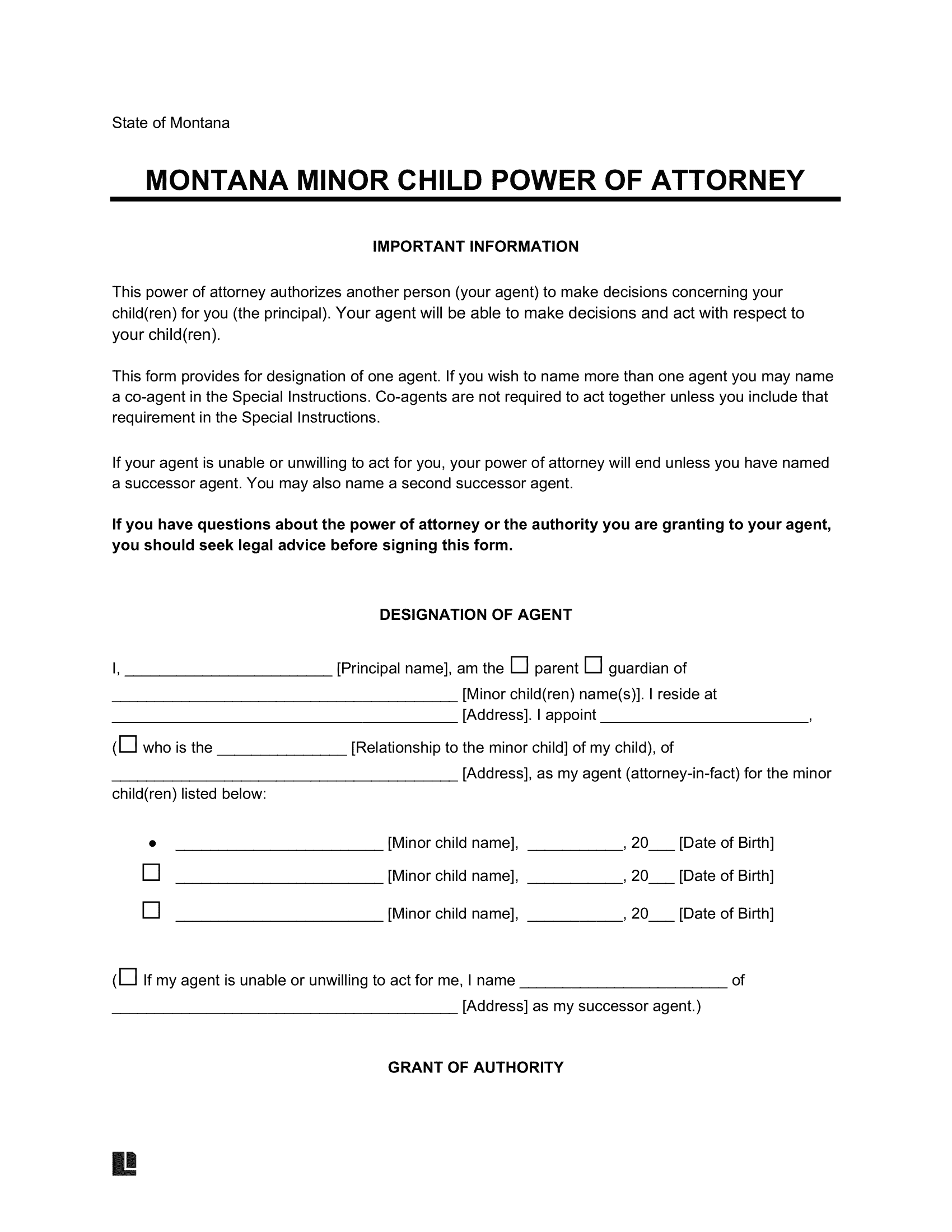
Review a sample Montana minor (child) power of attorney form below to see how you can assign a trusted adult temporary authority to care for your child. Legal Templates’s guided questionnaire helps you create this document in accordance with Montana’s six-month delegation rule. Once you’re ready, complete your form and download it in PDF or Word format.