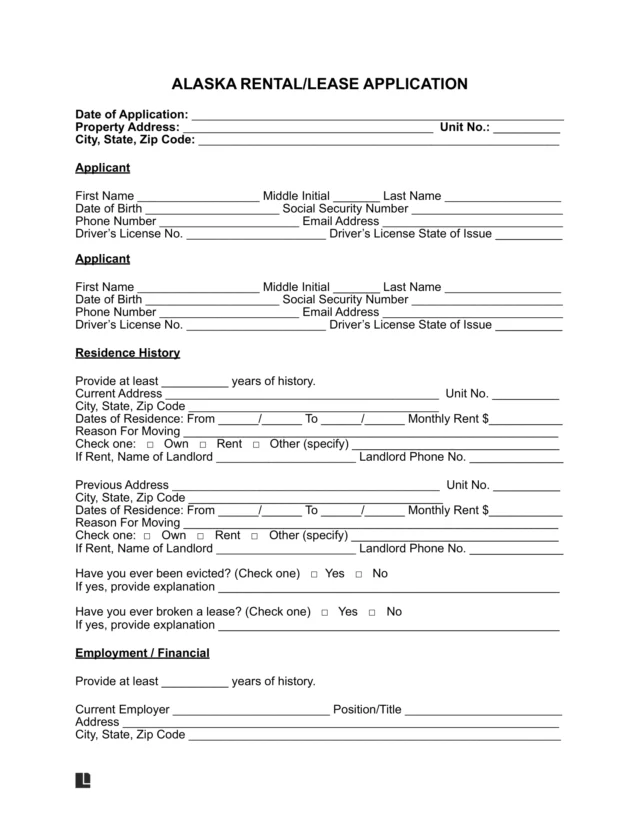
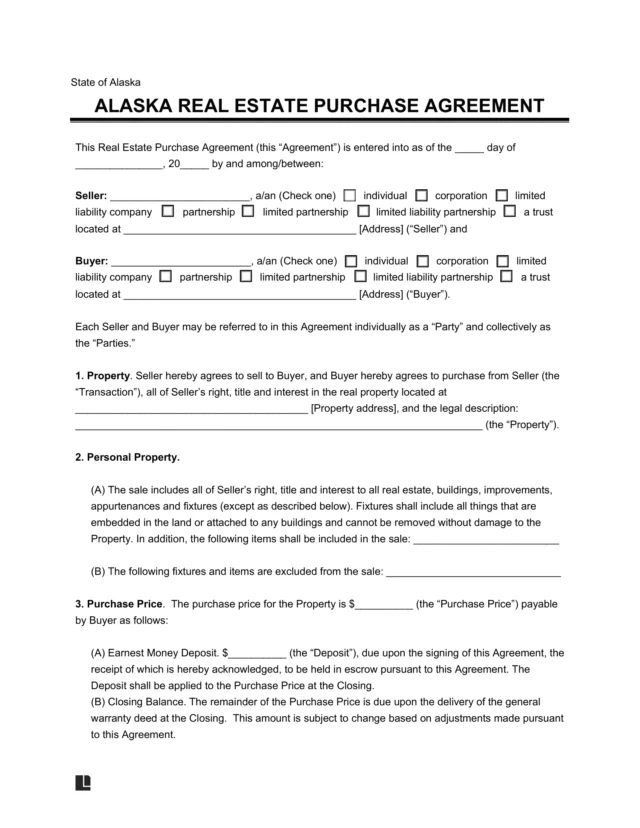
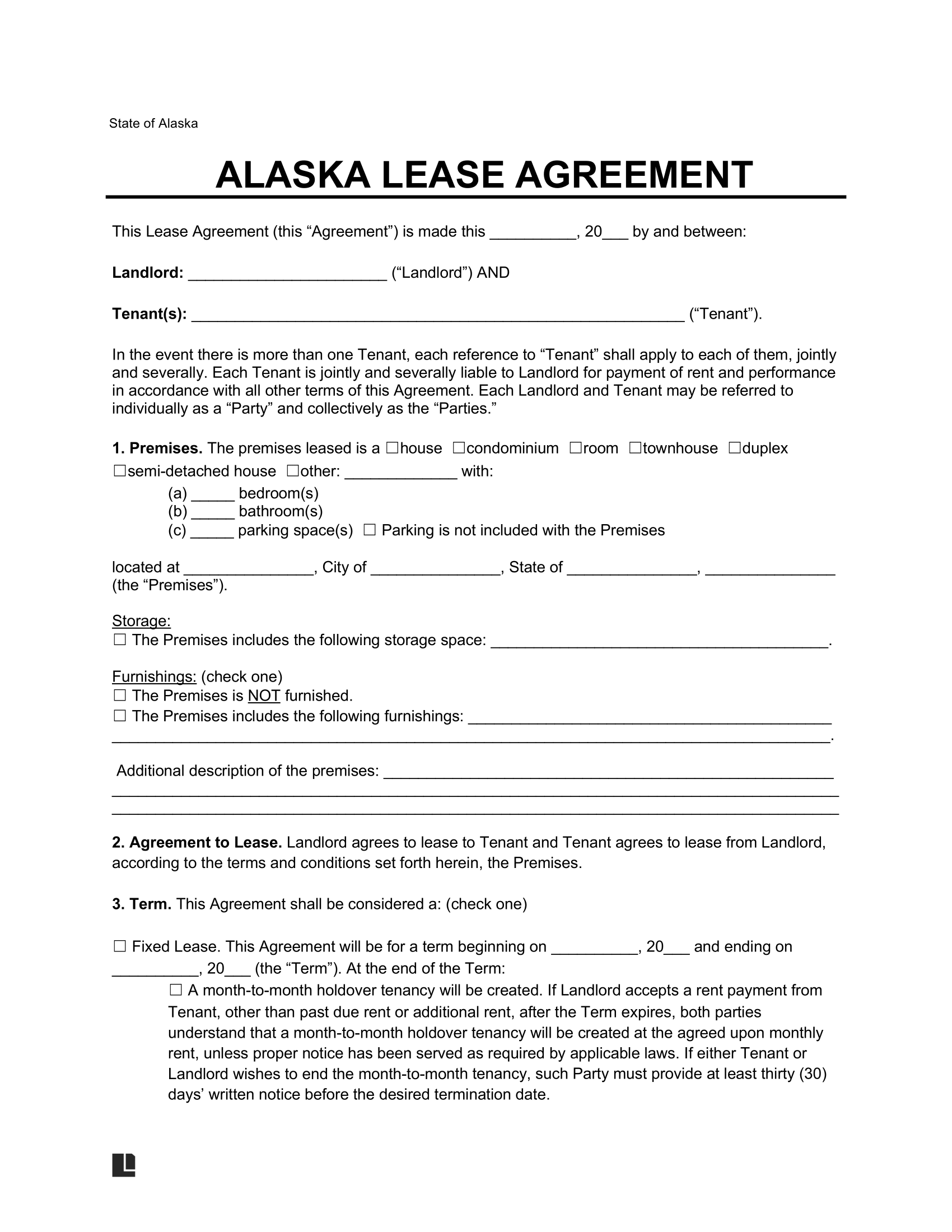
What Is an Alaska Lease Agreement?
An Alaska lease agreement creates a legally binding relationship between you (the landlord) and your tenant. You agree to rent your property for a fee, and the tenant agrees to the conditions outlined in the contract.
An Alaska rental lease agreement includes key details, such as the amount of rent, the security deposit, and the payment due dates. It also discloses any health hazards or risks and clarifies rules, like whether pets are allowed on the property.
Alaska Landlord-Tenant Laws Overview
An Alaska residential lease agreement is only enforceable if it follows state-specific laws. Review some of the key regulations to ensure that you understand what terms to include in your Alaska lease.
| Topic | Rule | Law |
|---|---|---|
| Security Deposit Maximum | Up to two months' rent; but if the rent is greater than $2,000/month, there is no security deposit maximum | AK Stat § 34.03.070(a) |
| Security Deposit Storage | Must be stored in a separate trust account with a bank or licensed escrow agent | AK Stat § 34.03.070(c) |
| Security Deposit Interest | Not required | n/a |
| Security Deposit Return | Within 14 days of the end of the tenancy (no damage) or Within 30 days of the end of the tenancy (if the landlord needs to account for damages) | AK Stat § 34.03.070(g) |
| Rent Control | None | n/a |
| Late Fee Maximum | The lesser of 5% above the Federal Reserve discount rate or 10.5% | Alaska Landlord-Tenant Act |
| Grace Period | n/a | AK Stat § 34.03.220(b) |
| Landlord Entry | 24 hours' notice, except in cases of emergency | AK Stat § 34.03.140 |
| Lease Termination | 30 days' notice | AK Stat § 34.03.290(b) |
Types of Alaska Lease Agreements
Depending on your property type and desired rental situation, you may need a specific type of Alaska lease. Legal Templates offers everything you may need, including a standard residential lease, a month-to-month lease, and a rent-to-own lease template. Review lease agreement templates for the state of Alaska below to find the one that fits your needs.
Alaska Standard Lease Agreement
Allows a tenant to occupy residential property in exchange for rent.
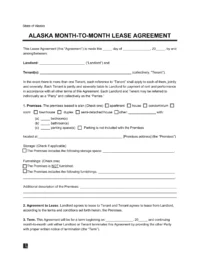
Alaska Month-to-Month Rental Agreement
Facilitates the short-term rental of a property.
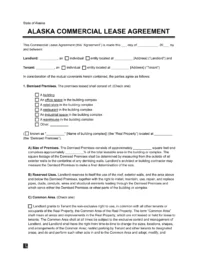
Alaska Commercial Lease Agreement
Describes the terms and conditions of renting a non-residential space.
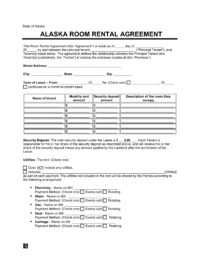
Alaska Room Rental Agreement
Establishes the rules for multiple tenants living on the same property.
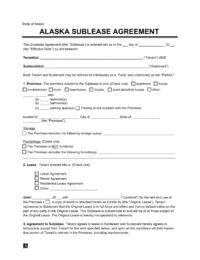
Alaska Sublease Agreement
Allows the subtenant to rent all or part of the leased property.
Alaska Rent-to-Own Lease Agreement
Enables an added option for the tenant to purchase the property.
Security Deposit Regulations in Alaska
When you enter an Alaska residential lease agreement with a tenant, you may choose to record a security deposit to protect your property. Alaska law lets you collect up to two months’ rent for a security deposit unless the monthly rent is greater than $2,000 (AK Stat § 34.03.070(a)). For properties where the rent exceeds $2,000 per month, you can charge a security deposit of any amount. Security deposits of any amount do not require a receipt.
Alaska landlords are not required to pay interest on security deposits. However, if the deposit accrues interest, the tenant is entitled to it.
Landlords must store security deposits in a separate trust account with a bank or licensed escrow agent. They can include prepaid rent in the same account, but must not commingle any other funds (AK Stat § 34.03.070(c)).
If there’s no damage to the property, and the tenant has provided proper notice to vacate, a landlord must return a tenant’s security deposit within 14 days of the end of the lease. Otherwise, a landlord may return the remaining security deposit within 30 days (AK Stat § 34.03.070(g)).
The landlord must disclose the specific terms and conditions for withholding the security deposit to the tenant.
Alaska Rent Payment Rules
Rent is due on the specific date outlined in the Alaska residential lease agreement. It must be paid at the designated time and location (AK Stat § 34.03.020(c)).
Alaska has no rent control laws, so landlords can charge any amount they’d like. However, they must follow fair housing rules and state laws for rent increases for periodic leases.
Late rent fees must be written in the Alaska rental contract. By law, they’re capped at the lesser of 5% above the Federal Reserve discount rate or 10.5% (Alaska Landlord-Tenant Act).
Alaska doesn’t impose a grace period, so a landlord can issue a 7-day notice of nonpayment of rent as soon as rent is overdue (AK Stat § 34.03.220(b)).
Landlord Entry Regulations in Alaska
A landlord must provide a tenant 24 hours’ notice before entering the rental property (AK Stat § 34.03.140). They must only enter at reasonable times to respect the tenant’s privacy. In emergencies, landlords are not required to provide notice before entering.
Tenants generally need landlord permission to change locks, except in emergencies. If the tenant changes the locks due to an emergency, they must give the new keys to the landlord within five days (AK Stat § 34.03.120).
Alaska Landlord and Tenant Property Repair Responsibilities
Landlords in Alaska have various duties to their tenants, including the following (AK Stat § 34.03.100):
- Supplying running water and reasonable amounts of hot water
- Providing waste disposal services
- Maintaining plumbing, heating, kitchen, and ventilation systems
- Keeping all common areas clean and sanitary
- Making repairs as needed
When a landlord and a tenant enter an Alaska lease agreement, it creates a reciprocal relationship. This means tenants also have various obligations to uphold, including the following (AK Stat § 34.03.120):
- Keeping their portion of the premises clean and fit
- Maintaining smoke and carbon monoxide detectors
- Allowing their neighbors to enjoy the property peacefully
- Using all systems, like plumbing, electrical, etc., in a reasonable manner
Required Lease Disclosures in Alaska
Landlords must make the following disclosures in an Alaska lease agreement:
- Disclosure of Lead-Based Hazards. Landlords of any building constructed before 1978 must notify all tenants of the potential existence of lead-based hazards (42 US Code § 4852(d)).
- Property Abandonment. Tenants must notify the landlord if they’ll be away from the property for seven days or more (AK Stat § 34.03.150).
- Property Manager. The landlord must provide the name and contact information of the person who manages the property and the owner (AK Stat § 34.03.080).
Terminating a Lease in Alaska
Either party must provide a 30-day notice to end a month-to-month lease (AK Stat § 34.03.290(b)). Landlords must provide a 15-day notice for tenants to collect personal belongings after lease termination (AK Stat § 34.03.260). If the items remain unclaimed, landlords have the right to sell valuables and dispose of them.
Alaska Lease Agreement Sample
View a free example of an Alaska lease agreement to see what terms need to be included. Use Legal Templates’s guided form to create your own and add your terms and conditions. Then, download the document as a PDF or Word file.