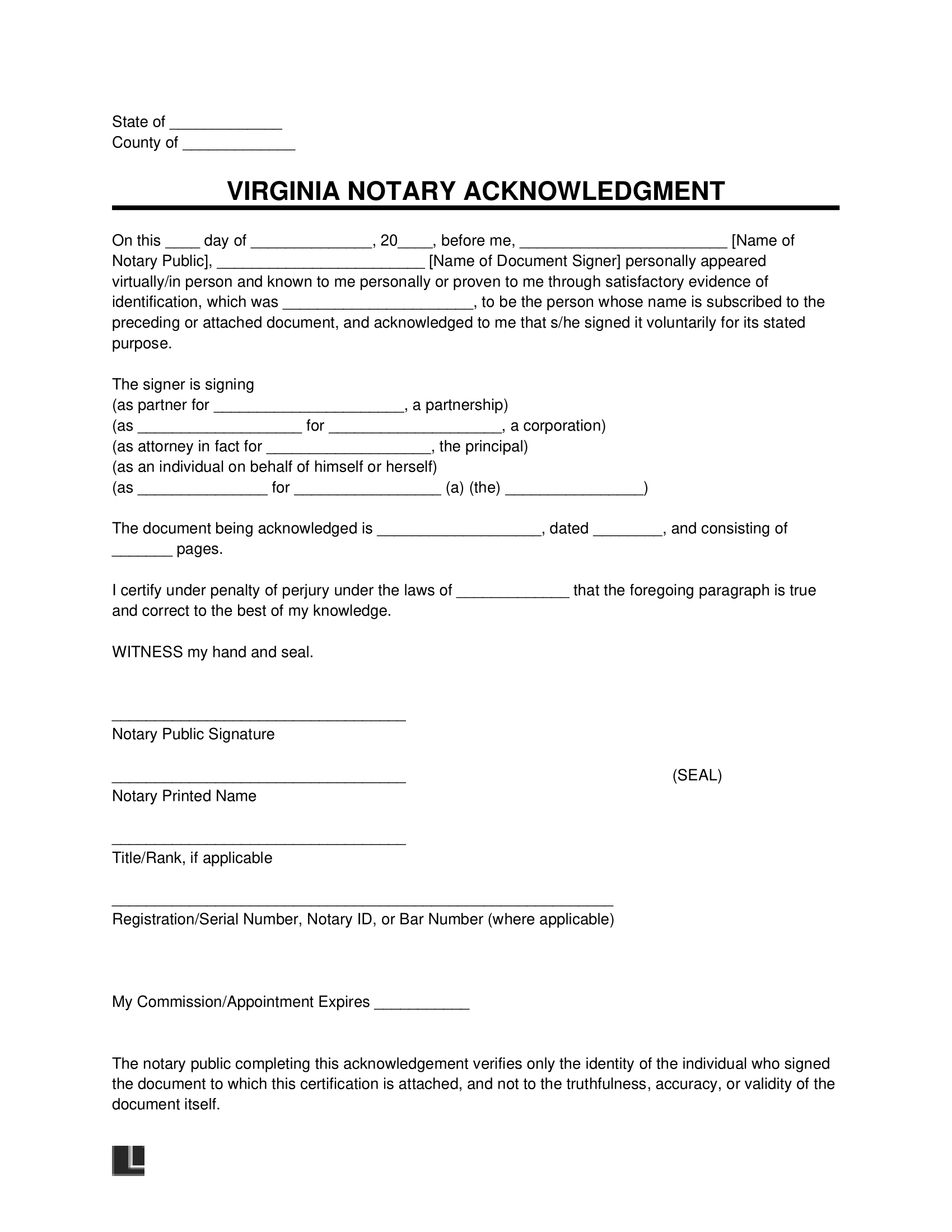
What Is a Virginia Notary Acknowledgment Form?
A Virginia notary acknowledgment form confirms that a signer appeared before a notary, proved their identity, and acknowledged signing a document (VA Code § 55.1-618).
The notary checks the signer’s identity using a valid ID or other reliable proof. However, the notary doesn’t review or validate the document’s contents (VA Code § 55.1-616). They only confirm that the signer acknowledged signing it.
What to Include in a Virginia Notary Acknowledgment Form
A Virginia notary acknowledgment form only works if it clearly shows that the signer appeared before a notary and confirmed the signature. Make sure your form includes:
- Proof the signer appeared: State that the signer appeared before the notary and acknowledged signing the document.
- Signer and document details: Include the signer’s name, the date, and the document name or description.
- How identity was confirmed: Note how the notary confirmed the signer’s identity (like a government-issued ID).
- The notary’s details: Add the notary’s signature, printed name, title, and official seal or stamp.
- Clear acknowledgment wording: Keep it simple with wording like “acknowledged before me” to show the signer confirmed the signature (VA Code § 55.1-619).
- The signer’s role, if needed: Include this if the signer is acting for a business or another person.
Including each of these details helps make sure your acknowledgment is complete and properly formatted, so it’s ready to be accepted when you submit or record the document. Legal Templates helps you put them together in a ready-to-use Virginia notary acknowledgment form.
Your form works in Virginia as long as it clearly shows the signer appeared and acknowledged signing.
Sample Virginia Notary Acknowledgment Form
View a sample Virginia notary acknowledgment form to see how it’s set up. Then customize and download your template in Word and PDF.
Is Online Notarization Legal in Virginia?
Yes. Virginia allows remote online notarization under VA Code § 47.1-11.1. A notary can complete an acknowledgment without meeting in person, as long as they’re authorized and follow state rules.
The signer appears remotely via approved audio-visual technology, so there’s no need to meet in person. The notary still checks the signer’s identity and confirms they acknowledge the document, just like in person.
When performing an electronic notarization, a notary must verify the signer’s identity using a knowledge-based authentication assessment and a credential analysis of their ID (VA Code § 47.1-2).
Documents That Typically Require Notarization in Virginia
Many legal and financial documents in Virginia need notarization to be accepted, recorded, or used later. It’s most common for documents related to property, finances, or legal authority. Here are some of the most common ones:
- Power of attorney forms
- Quitclaim deed forms
- Bill of sale forms
- Promissory note templates
- Affidavit templates
- Revocable living trust forms
- Last will and testament forms
- Satisfaction of mortgage forms
- Warranty deed forms
- Mortgage deed forms
- Self-proving affidavit for a will forms
- Lease agreements
In Virginia, some documents don’t legally require notarization, but it can still help. It adds proof, supports the validity of the document, and helps avoid disputes later.
Make sure the document is complete before notarization. A notary won’t notarize a document with blank spaces.