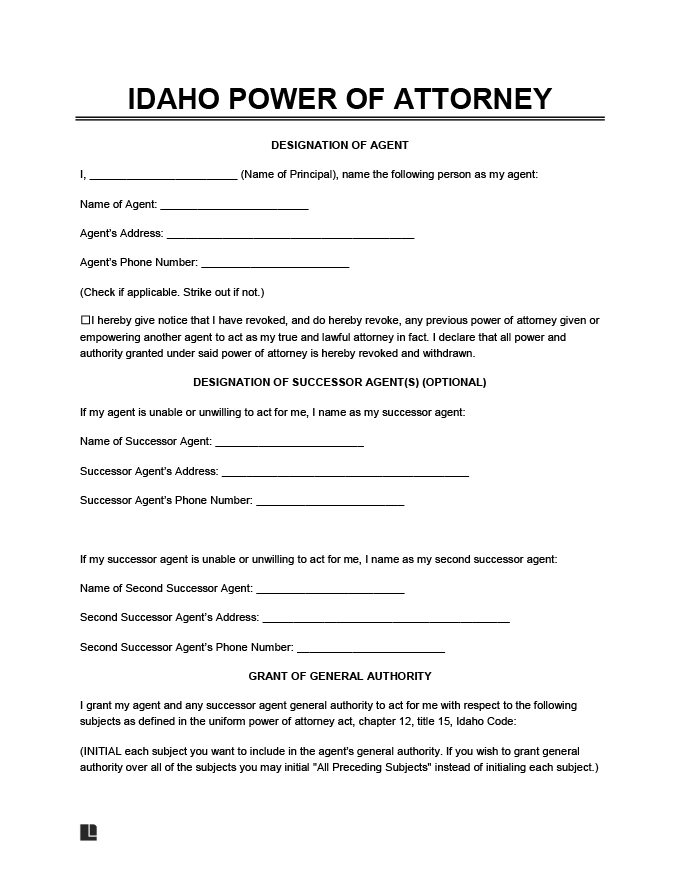
What Is an Idaho Power of Attorney?
An Idaho power of attorney is a legally binding document that gives one person the authority to make decisions for another. The principal creates the agreement and selects an agent to act for them. This agent may handle financial, medical, or legal matters on behalf of the principal.
Creating an Idaho POA requires you to follow the guidelines in Idaho Statutes, Title 15, Chapter 12. This act states that the principal must be at least 18 years old and of sound mind when creating this agreement.
Our free Idaho power of attorney forms can help you create a binding and compliant agreement. Use our document builder to customize your document and set the terms for you and your agent.
Types of Powers of Attorney in Idaho
You can use more specific forms to define the powers of attorney you want to give your agent. Idaho allows for durable and non-durable POAs and provides documents focused on financial or medical authorities. Compare the following types of powers of attorney in Idaho and choose the one that works for you.
Durable vs. Non-Durable
Making your POA either durable or non-durable helps to specify its purpose and limitations. A durable power of attorney provides that the agent maintains their authority after the principal becomes incapacitated. A non-durable contract revokes the agent’s powers when the principal is incapacitated. According to ID Code § 15-12-104, Idaho POAs are durable unless otherwise stated in the terms of the agreement.
Financial
You can use a financial power of attorney in Idaho to give your agent specific authority over your financial affairs. This document includes a list of powers that focus on handling monetary assets or property with financial value. The exact regulations and terms for an agent’s financial powers can be found in ID Code § 15-12-201 – 15-12-217. A financial POA can include any or all of the following permissions for your agent:
- Access to bank accounts
- Ability to pay bills
- Authority to make real estate transactions
- Power to make decisions on personal property
- Authority over stock and investment decisions
Medical
An Idaho medical power of attorney allows you to give your agent control over your healthcare decisions. Typically, the agent acts on your behalf if you can no longer communicate your wishes. You can provide your agent with the following authority in a medical POA:
- Access to medical records
- Authority to decide on life-sustaining treatments
- Decision-making powers about pain management
- Ability to hire or fire healthcare providers
Consider creating a living will to further outline your preferences for care in the event of your incapacitation. You can combine a living will with a medical POA to make an advance directive, often known as an advanced care planning document. The terms and requirements for an advanced care planning document are under Title 39, Chapter 45 of the Idaho Statutes.
Durable (Financial)
Allows the representative to continue making financial decisions on behalf of the principal should they become incapacitated. In Idaho, your POA is durable unless stated otherwise.
Signing Requirements: Notary public.
Limited (Special)
Grants limited powers to an agent for a specific task, and typically ends when the task has been completed.
Signing Requirements: Notary public.
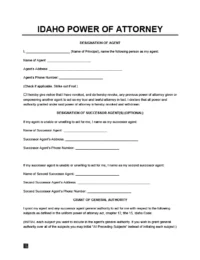
Non-Durable (General)
Gives an agent broad powers to handle your affairs and it’s often used for day-to-day financial matters. This document terminates when the principal becomes incapacitated.
Signing Requirements: Notary public.
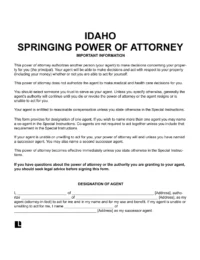
Springing
“Springs” into effect in a certain situation, and ends at a time you specify (e.g. if you become incapacitated).
Signing Requirements: Notary public.
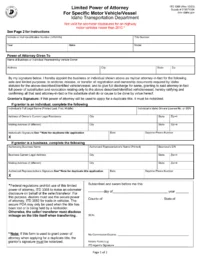
Motor Vehicle (Form ITD 3368)
Allows an agent to manage the principal's affairs in relation to motor vehicles.
Signing Requirements: Notary Public (if applying for duplicate title).
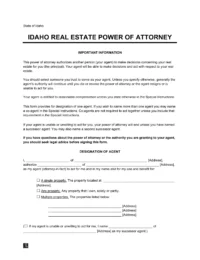
Real Estate
Allows a property owner to appoint an agent to manage their real estate transactions.
Signing Requirements: Notary public.
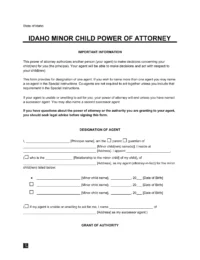
Minor (Child)
Enables parents to assign decision-making authority for their minor child to an attorney-in-fact.
Signing Requirements: Notary public.
How to Write a Power of Attorney for Idaho
Writing a power of attorney for Idaho requires you to follow state laws and include your desired terms. Use the following steps to create a POA and define the conditions for you and your agent:
- List the parties: Add the principal’s and agent’s full legal names and addresses. You can also add a successor agent if your primary agent is no longer willing or able to act.
- Grant general powers: Give your agent any or all the general authorities available for an Idaho POA in ID Code 15-12-204 through 15-12-216. This may include access to bank accounts, medical records, and power over real and personal property.
- Express specific authorities: More complex authorities may require you to provide permissions in the specific authorities section of the agreement. This section may include power over gifts, trusts, and beneficiaries as listed in ID Code § 15-12-201.
- Add special instructions: Use the special instructions of your POA to provide any specific wishes or conditions for your agent. You can write in your desired authorities or terms.
- Set the effective date: Choose when you want the agent’s powers to go into effect. According to ID Code § 15-12-109, a POA is effective at the time of execution unless you provide a specific date or event for effectiveness.
- Review and sign: Complete your agreement by reviewing your terms, adding supporting documents, and choosing the durability of your contract. Then, sign and date the document to finalize and begin your arrangement.
Idaho Legal Considerations & Requirements for a POA
State laws play a large part in creating a legally valid and enforceable POA. Consider the following requirements and considerations included in Idaho’s power of attorney laws.
Notarization
Have your power of attorney notarized to ensure the state considers it valid and allows your agent to exercise their authority. According to ID Code § 15-12-105, the POA and principal’s signature are assumed to be genuine when acknowledged by a notary public. Also, check the relevant laws, as specific types of powers of attorney may require additional witnesses.
Filing
Idaho state law doesn’t require filing for a general power of attorney. However, if your agent holds power over real estate transactions, you must file the document with the County Clerk and Recorder’s Office where the property is located. Other financial and medical institutions will also request a copy of your POA form to verify the agent’s abilities.
Revocation
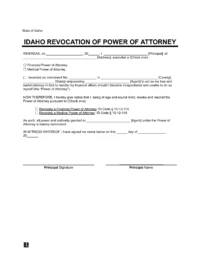
The principal or agent may revoke the powers of attorney at any time. ID Code § 15-12-110 states that actions taken by the agent before their awareness of a revocation remain legal and valid as long as they were taken in good faith. This statute also provides guidelines for various methods of revocation, such as:
- Principal incapacitation: In a non-durable contract, the principal’s incapacitation triggers an automatic revocation of the agent’s authority.
- Principal revocation: The principal may write and provide the agent with a revocation of power of attorney form at any time. Once the agent receives this notice, they no longer hold the authority provided by the POA.
- Terms of the agreement: Your original agreement can include terms for an event or date that spur the revocation of your agent’s powers.
- Divorce or legal separation: If your spouse acts as the agent, a divorce or legal separation will end the terms of the POA agreement.
- Agent resignation: If the agent is no longer willing or able to serve the principal, they may provide a written agent resignation form. This ends the agreement and may pass powers to a successor agent or conservator, depending on the original contract’s terms.