What Is a Farm Purchase Agreement?
A farm purchase agreement is a written contract between a buyer and a seller for the sale of farmland. While a farm purchase agreement usually covers the farmland itself, it may also cover:
- Ranch property
- Farmhouses
- Barns
- Silos
- Crops
- Livestock
- Farm equipment
Once signed by both parties, the farm purchase agreement becomes a legally binding contract. It identifies all parties involved and outlines the terms of the sale. This helps protect the buyer’s investment and ensures the seller is paid as per the agreement. Moreover, it also reduces the risk of disputes over property, boundaries, included assets, or payment terms in the future.
When Do You Need a Farm and Ranch Purchase Agreement?
A farm and ranch purchase agreement is helpful when buying or selling farmland or related property. Farms and ranches are valuable assets, and having a written contract for the transaction can protect both parties.
A farmland purchase agreement helps address the unique details of farm transactions, such as livestock, equipment, or even multiple structures, that a land contract may not cover.
You can use a farm and ranch purchase agreement if you are:
- Buying or selling farmland: This helps put the sale in writing so that the terms are clear for both parties.
- Purchasing a ranch or agricultural land: Other assets, such as animals, crops, or farm tools and equipment, may be included and can be documented.
- Transferring farm buildings: Barns, silos, or houses on the land can be listed in the agreement.
- Selling farmland with extras: Equipment, crops, or grazing rights can be added to the contract to avoid confusion.
Why Use a Farm Purchase Agreement?
Buying or selling farmland is usually a significant investment, and a written agreement helps protect that investment. Without one, you risk being involved in disputes that can lead to costly lawsuits. In worst-case scenarios, it can even end in the loss of your property.
Here’s why it is important to use a farm purchase agreement:
- Provides legal protection: A signed agreement protects both the buyer and the seller
- Prevents disputes: The agreement clearly outlines boundaries, equipment, crops, and livestock, so there’s no confusion about who owns what.
- Creates enforceability in court: Most states require all real estate sales to be in writing under the Statute of Frauds. For example, the Texas Business and Commerce Code § 26.01 and California Civil Code § 1624 both say land contracts must be in writing to be valid.
- Covers complex transactions: Unlike a standard land purchase agreement, a farm purchase agreement may also cover barns, livestock, crops, or equipment. This ensures that all assets involved in the sale are clearly documented and included within the contract.
How to Write a Farm Purchase Agreement
Follow these steps to create a complete farm purchase agreement.
Step 1 – Add the Date
Start by adding the date when the farm purchase agreement is made.
Step 2 – Name the Buyer and Seller
List the full names and addresses of both parties. Clearly note if they are individuals or businesses.
In some states, both spouses must sign if the property is a marital or homestead property, even if only one spouse is on the title (e.g., Massachusetts (General Law Ch. 209 Sec. 1), Florida (Constitution Art. X Sec. 4), Nebraska (Rev. Stat. § 40-104)).
Step 3 – Describe the Farm
Write the property’s address, size, and legal description. Include any barns, silos, or other buildings. Clearly state whether crops, water rights, grazing rights, or mineral rights are part of the sale.
Step 4 – Write the Price and Payment Terms
State the total price and how it will be paid. Include details about deposits or escrow. Some states, such as Georgia, regulate escrow deposits (Georgia Code Title 44, Chapter 7).
Step 5 – Explain the Financing
Note whether the buyer will pay in cash, get a loan, or take over the seller’s loan. Note any financing contingencies that must be met before closing.
Step 6 – List Disclosures and Warranties
The seller should state that there are no hidden problems, such as liens, zoning issues, or environmental hazards, and make any other disclosures that are required by state and federal law. Some states, such as Iowa (Iowa Code § 558A), require a formal property condition disclosure.
Step 7 – Set the Closing Details
State the closing date, location, and responsibilities of each party. List what each party must bring or do, and state who will pay the closing costs.
Step 8 – Decide on the Possession Date
Include the date when the buyer will officially take over the property. If crops or livestock are part of the sale, state who is responsible until the handover is complete.
Step 9 – Add Miscellaneous Provisions
List any other important details, such as inspection rights, title insurance, or how disputes will be handled if they come up.
Step 10 – Sign the Agreement
Both the buyer and the seller must sign the farm purchase agreement. Electronic signatures are valid in most states under the Uniform Electronic Transactions Act (UETA), and while notarization is not always required, it can add extra legal protection.
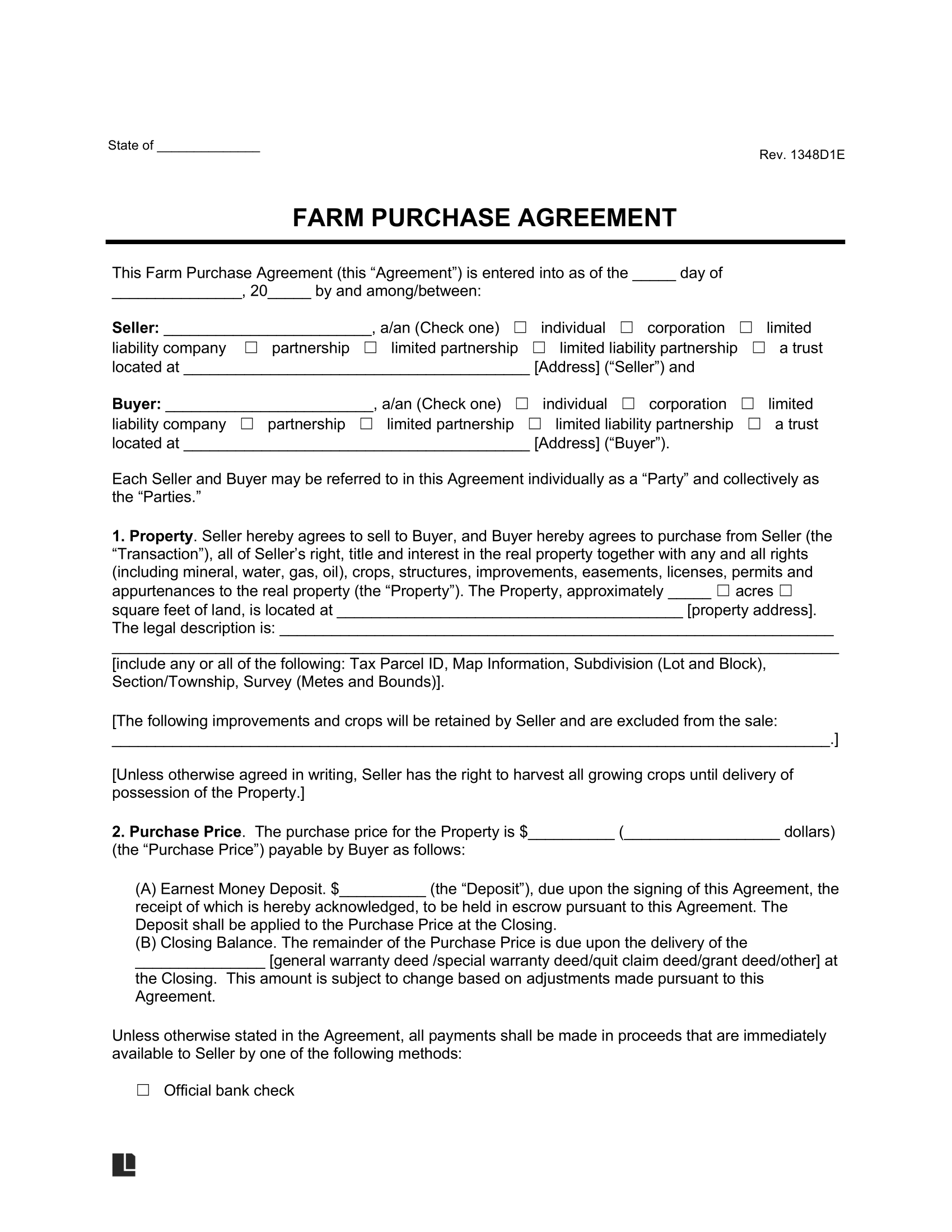
Sample Farm Purchase Agreement
View our sample farm purchase agreement template below, which shows how the terms of a farm and ranch sale can be written. Then, follow our step-by-step questionnaire to fill out and download your farm purchase agreement as a PDF or Word file.